




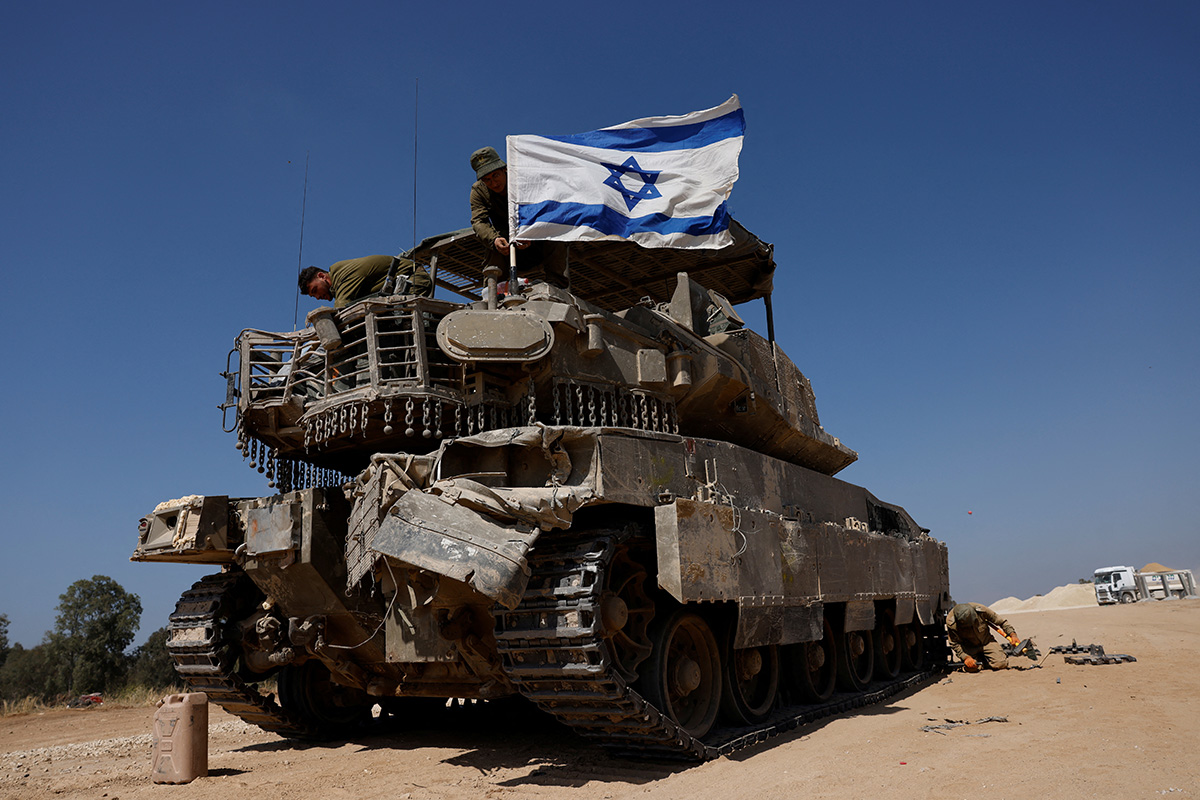
French-Israeli journalist and filmmaker Pierre Rehov joined Chicago’s Morning Answer to offer a deeply personal and unflinching account of life near the Gaza border amid ongoing military tensions, Iranian missile strikes, and Israel’s campaign against Hamas. Speaking from Ashdod, roughly 20 kilometers north of Gaza, Rehov detailed recent nights interrupted by missile sirens and underscored the vulnerability of Israeli civilians—particularly in areas not directly targeted but still within striking range.
Rehov, who has lived in Israel for 14 years, placed the current conflict in a broader religious and ideological context. He argued that the Iranian regime’s actions—particularly its missile attacks on civilian areas—are driven not just by geopolitics but by religious extremism. In his view, the hatred of Israel and the United States by regimes like Iran stems from a theocratic worldview rooted in a medieval mindset. For these regimes, he said, modern liberal democracies represent an existential threat.
He dismissed claims that recent Iranian strikes on Arab neighborhoods within Israel were strategic missteps or attempts to inflame local tensions. Rather, he said, the missiles are not highly targeted and Iran simply doesn’t care who gets hurt as long as their ultimate aim—Israel’s destruction—is pursued. Rehov noted a recent near-miss of a hospital in southern Israel, where an instinctive evacuation by the hospital’s director the day prior may have saved hundreds of lives.
While the broader regional crisis has drawn international attention, Rehov was critical of global narratives that paint the conflict as one of moral equivalence. He warned that Iran’s nuclear ambitions and its support for terror proxies across the region are an existential threat not just to Israel but to global security. He emphasized that if Iran succeeds in acquiring nuclear weapons, the consequences would reach far beyond the Middle East.
Rehov also had harsh words for the government of Qatar, which he accused of playing a “double game” by hosting Hamas leadership while projecting a softer diplomatic image. He described Qatar as a key enabler of Hamas and a corrupting force in global institutions, including universities and political systems in the West.
Addressing the situation in Gaza, Rehov estimated that 80% of the territory has been destroyed and is now uninhabitable. He was blunt in describing the humanitarian crisis, arguing that much of the aid sent to Gaza has been hijacked by Hamas and resold on the black market to fund continued operations. He supported efforts to reform the distribution process, saying the current Israeli-American coordination has allowed aid to reach civilians more securely. Rehov cited reports of Gazans expressing support for Israel and the U.S. at distribution points, suggesting a shift in public sentiment as people begin to blame Hamas for their suffering.
He criticized the United Nations, particularly its aid agencies operating in Gaza, accusing them of being infiltrated by Hamas and spreading misinformation about famine conditions. According to Rehov, the UN has long enabled Hamas by tolerating or overlooking its control of aid pipelines and its political manipulation of civilian needs.
Looking ahead, Rehov said Israel must expand its focus beyond Hamas to target the larger network of state sponsors and ideological supporters of terrorism, particularly Iran and Qatar. He acknowledged that hostages still held in Gaza complicate military operations but stressed that long-term peace in the region depends on dismantling the infrastructure that allows terror groups to thrive.
Rehov’s recent book October 7th: The Response and his documentary Pogroms chronicle the atrocities of the October 7 Hamas attacks and their aftermath. Both works aim to counter what he sees as a dangerous misinformation campaign in Western media and international institutions, and to document the stakes of Israel’s fight for survival.