




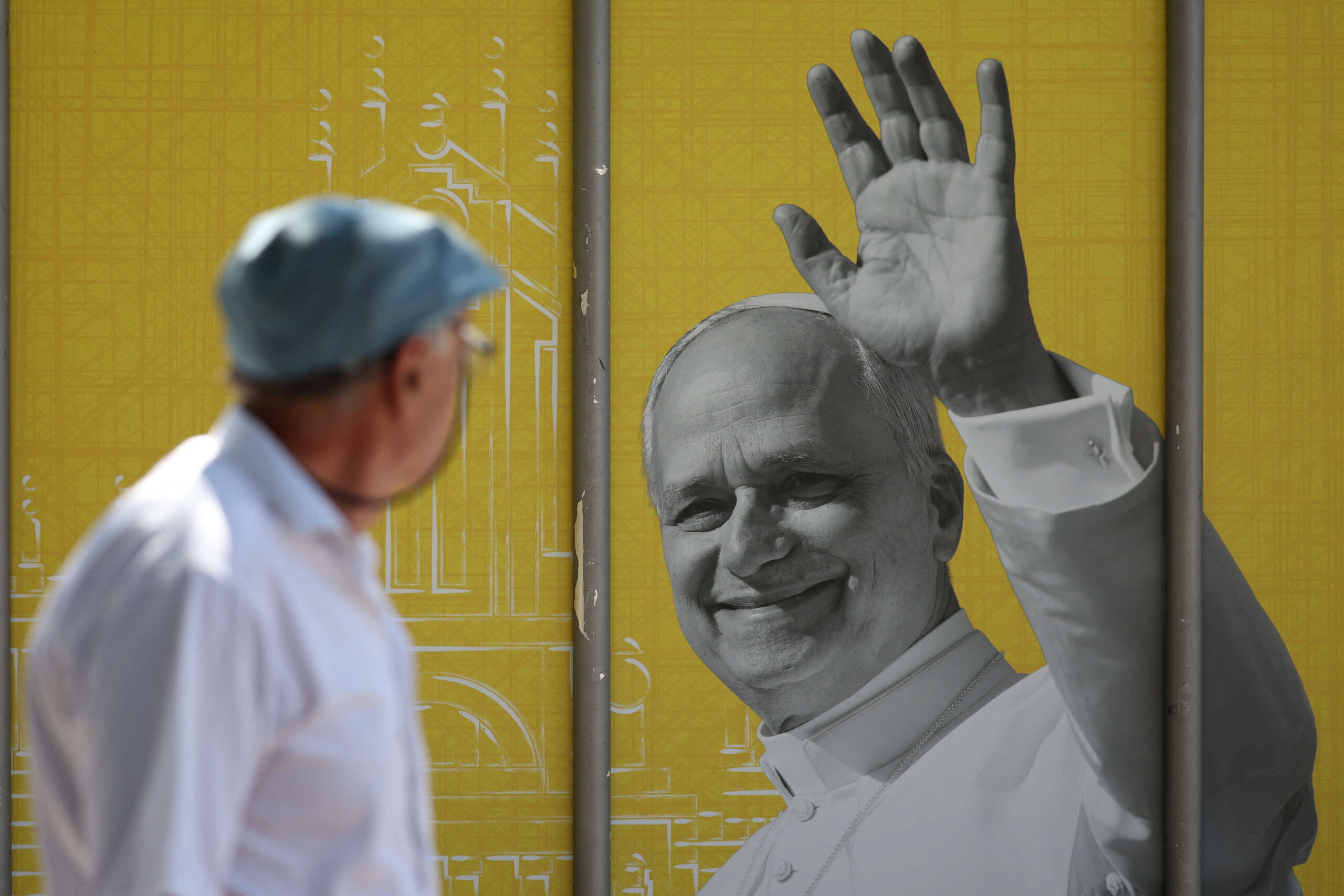
Pope Leo XIV’s encyclical on artificial intelligence, Magnificat Humanity, drew significant commentary this week, particularly around remarks by Anthropic co-founder Chris Olah, who was invited to address the pontiff and those in attendance at its release. Olah named three questions he believes the church’s voice is especially needed on: the duty to the global poor who may be displaced by AI labor disruption and who risk being excluded from its benefits given that development is concentrated in a handful of wealthy nations; the need for moral imagination about what human flourishing looks like in an AI-saturated world; and the genuinely unsettling question of what is actually happening inside these models, where researchers keep finding structures that mirror human neuroscience, evidence of introspection, and internal states that functionally mirror emotions including joy, satisfaction, fear, and grief.
Neil Chilson, former chief technologist for the Federal Trade Commission and currently head of AI policy at the Abundance Institute, joined Dan Proft on Chicago’s Morning Answer to assess the encyclical and the broader questions Olah’s remarks raised.
Chilson said Proft’s response to the economic distribution question, which drew on Milton Friedman’s point that free markets distributing rewards based on voluntary exchange rather than political favor have historically done more for the poor than any alternative system, is exactly right, and that the mechanism for distributing AI’s benefits globally already exists. He said the human flourishing question is actually the central point of the encyclical, which Pope Leo XIV has structured as a conscious parallel to an encyclical written by Pope Leo XIII roughly a hundred years into the industrial revolution. That earlier document was highly influential in shaping Catholic social teaching about government and economic transformation. The key difference, Chilson said, is that Leo XIII wrote with a century of industrial evidence already in hand, while Leo XIV is writing much earlier in a transformation whose effects are still largely speculative. That makes the task considerably harder and means the encyclical necessarily relies more on academic speculation about what AI might do than on documented outcomes.
He said the encyclical’s Tower of Babel concern, which is essentially a worry about technological and linguistic uniformity producing a kind of lock-step conformity that tends toward tyranny, is one he takes seriously as a philosophical matter but does not see playing out in the actual current landscape. He said the reality of how AI is developing right now is almost the opposite of the Babel scenario. The effects are highly dispersed, emerging from millions of individual users solving individual problems rather than from a grand social redesign. New cancer cures are being developed. Autonomous vehicles are operating hundreds of times more safely than human drivers. People are solving office productivity problems. There is not, at present, a powerful entity using AI to redesign society from the top down according to a unified vision. He said he genuinely appreciates the encyclical’s concern about that possibility because it is a real risk if the technology concentrates in the wrong hands, but said the muddling-through approach that has characterized how humans have adopted past technological revolutions has generally produced remarkably good outcomes because humans are good at solving problems with powerful tools even when they sometimes misuse them.
On the Wall Street Journal piece that Harvard’s Arthur Brooks and CNBC’s Becky Quick discussed, which documented how the memory function in AI chatbots can create problems when a model remembers a past statement about stress or anxiety and then permanently categorizes the user as anxious regardless of changed circumstances, Chilson said this is a real but relatively minor design problem of exactly the kind that users recognize, complain about, and companies correct. He said the deeper concern Brooks and the encyclical are both circling is about cognitive atrophy, the risk that offloading thinking and reading and remembering to AI tools gradually weakens the human capacities being replaced. He noted that Plato raised an analogous concern about writing, arguing that it eroded the ability to memorize long oral traditions. The more important question is not whether specific functions atrophy when tools assist them, but whether the core things that make us human can be offloaded at all, and whether the tools we use serve our greater purpose or diminish it.
His answer to those questions is that they cannot be resolved from above and should not be. The right response to AI is many different experiments by many different people and institutions, not a grand dictated framework for how everyone must engage with the technology. He said good wisdom about how to use these tools in ways that serve human dignity can be offered by people and institutions with deep experience, including the church, but ultimately how each person chooses to engage with AI has to be an individual choice. Dictating that choice from outside is itself dehumanizing, regardless of how good the intentions behind the mandate might be.
He closed with a laugh on the prospect of the next stage, which is people using one AI bot to manage their interactions with another AI bot, observing that the phrase I’ve got an app for that is on its way to becoming I’ve got a bot for that bot.