




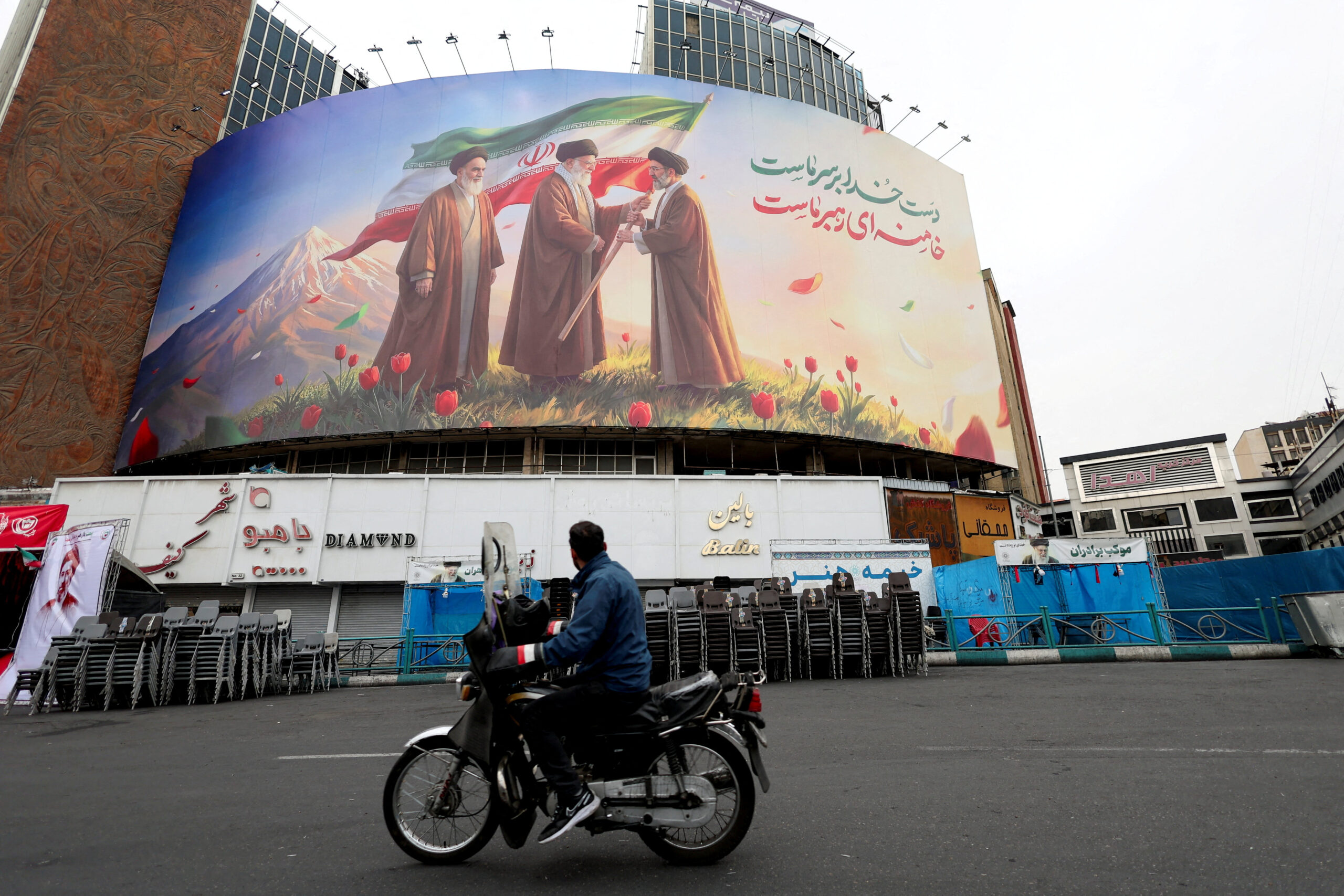
The U.S. military campaign against Iran has achieved significant early successes but still faces critical strategic challenges, particularly involving control of key maritime routes and the dismantling of Iran’s remaining military capabilities, according to foreign policy analyst Clifford May.
May, president of the Foundation for Defense of Democracies, said the current phase of the operation reflects a strategy aimed not only at degrading Iran’s military assets but also at ensuring the regime cannot quickly rebuild its capacity to threaten the region or pursue nuclear weapons.
“A lot has been accomplished,” May said. “But there’s still a lot more that needs to be done before this effort is complete.”
President Donald Trump has publicly emphasized the progress made so far, pointing to the destruction of large portions of Iran’s naval and air defense capabilities. At the same time, administration officials have acknowledged that operations will continue as long as necessary to eliminate remaining threats, including missile launch sites and facilities linked to Iran’s nuclear program.
May said the administration’s objective appears to be preventing Iran from recovering militarily once the fighting subsides.
“What the president doesn’t want is to beat the opponent in the ring for a while and then let him go back to his corner, recover, and come back stronger,” May said.
The Iranian regime, he noted, has historically been unwilling to abandon its ideological goals, which include expanding its influence throughout the Middle East.
“The Islamic Revolution of 1979 was built on the idea of spreading the power of an Islamic state across the region,” May said. “Their slogans—‘Death to Israel’ and ‘Death to America’—are not just rhetoric. They reflect the regime’s core ambitions.”
One of the most pressing operational issues involves the Strait of Hormuz, a narrow waterway through which roughly 20 percent of the world’s oil supply passes. Ongoing disruptions in the strait have contributed to rising energy prices in global markets.
May said the United States has the capability to secure the waterway but acknowledged that the exact timeline for restoring normal shipping traffic remains uncertain.
“This is one of the most strategically important waterways in the world,” he said. “Freedom of the seas is a foundational principle of international law, and right now that freedom is being challenged.”
Iran has already lost many of the vessels used to lay naval mines, but the country retains other methods for disrupting shipping, including small fast attack boats, drones, and improvised mine deployments from civilian-style vessels known as dhows.
Despite those tactics, May said Iran also faces limitations. Because the country continues to export oil through the same waters, completely blocking the strait would damage its own economy.
“They can try to disrupt shipping, but they can’t fully close the strait without hurting themselves,” he said.
May argued that a decisive U.S. role in securing the strait would carry major geopolitical implications, including increased leverage over China, which depends heavily on Middle Eastern oil shipments.
“If the United States guarantees freedom of navigation there, it also gains strategic leverage,” May said. “China relies on that oil.”
The stakes extend beyond the immediate military conflict. Control of the Strait of Hormuz, along with the Bab el-Mandeb Strait near the Red Sea, could influence global trade routes and energy security for years to come.
May suggested that allowing hostile governments or militant groups to control those chokepoints would pose a long-term risk to international commerce.
“The alternative is leaving critical global trade routes in the hands of rogue regimes or terrorist proxies,” he said.
Beyond maritime security, another concern is the possibility of retaliation against the United States or its allies. Intelligence officials have warned for years that Iran maintains networks capable of carrying out attacks abroad.
May said the possibility of sleeper cells operating in the United States cannot be ruled out, particularly after years of increased migration and security concerns at the southern border.
However, he emphasized that Iran’s direct military ability to strike the U.S. mainland with missiles or drones remains limited.
“They don’t currently have the capability to launch missile or drone attacks that could reach California,” May said. “But they were working toward that capability.”
One goal of the current military campaign, he said, is to prevent Iran from developing long-range strike capabilities before they become operational.
“This is the kind of threat that people often dismiss until it’s too late,” May said.
The broader strategic objective, he added, is preventing Iran from joining a group of adversarial powers—including Russia, China, and North Korea—that possess nuclear weapons and delivery systems capable of threatening Western nations.
“The last thing you want is multiple hostile regimes with nuclear weapons and long-range missiles telling the United States what it can and cannot do,” May said.
While the military operation has significantly weakened Iran’s conventional forces, May said the long-term outcome will depend on whether the regime can be prevented from rebuilding its capabilities.
For now, he said, the campaign represents a major shift in U.S. policy after years of diplomatic efforts that failed to halt Iran’s nuclear ambitions.
“Every administration has said a nuclear-armed Iran is unacceptable,” May said. “The difference now is that someone is actually trying to stop it.”