




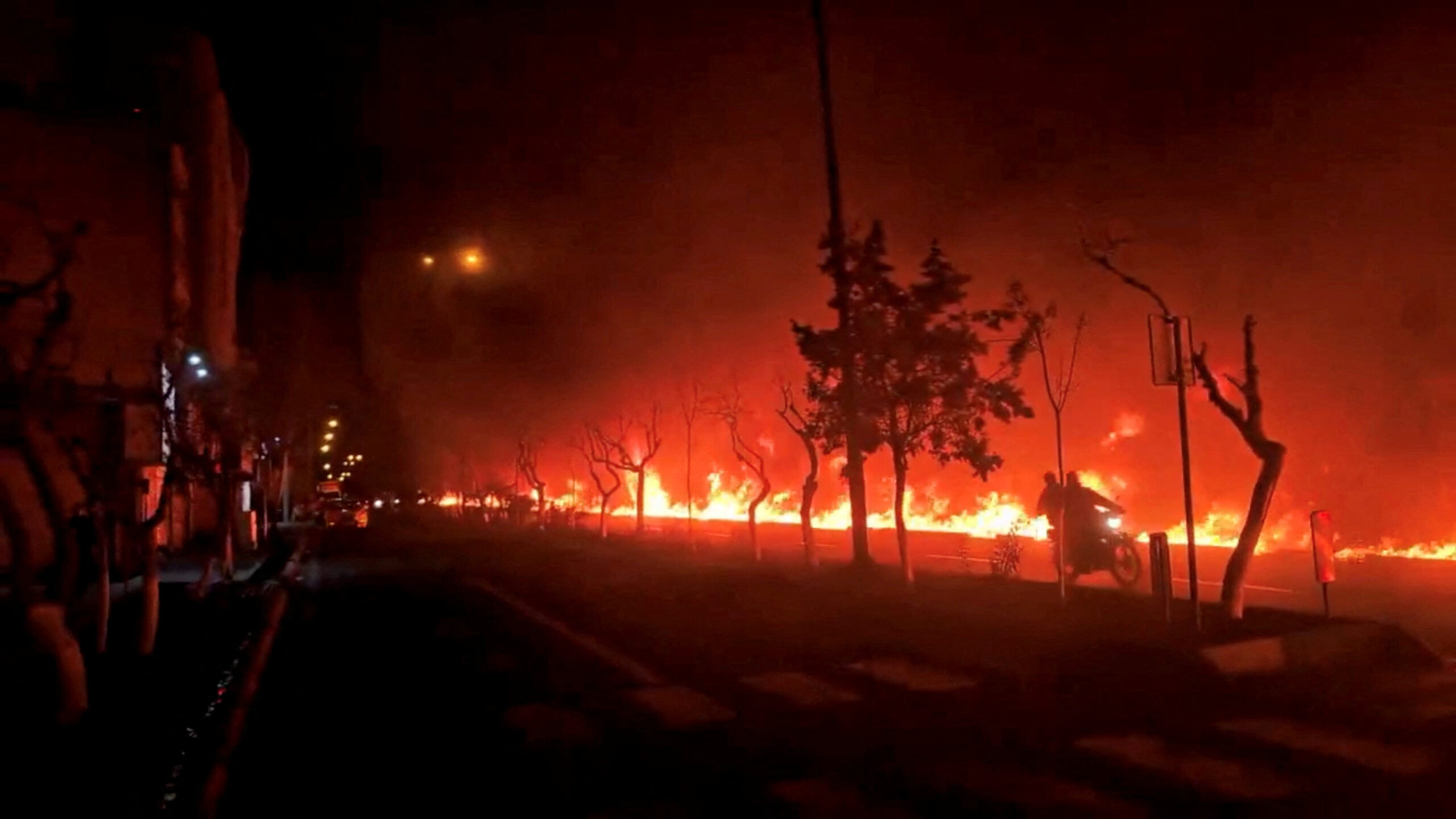
As U.S. military operations against Iran continue, foreign policy analysts say the early success of the campaign does not necessarily guarantee a long-term strategic victory.
Justin Logan, director of defense and foreign policy studies at the Cato Institute, said the opening phase of the conflict has demonstrated the overwhelming capabilities of the U.S. military but cautioned that achieving broader political goals may prove far more complicated.
“The military instrument is incredibly effective,” Logan said. “But at the end of the day it’s a political tool designed to produce political outcomes.”
The conflict began after the United States launched strikes targeting Iran’s military infrastructure and leadership. President Donald Trump later said the campaign had already severely degraded Iran’s naval forces, missile launch sites, and air defense systems, while also disrupting drone production facilities.
Despite those tactical successes, Logan said the administration faces a familiar dilemma in modern warfare: how to translate military victories into durable political outcomes without committing to a prolonged and costly conflict.
“My sense of Trump’s foreign policy is that it’s very casualty-averse and cost-averse,” Logan said. “He clearly doesn’t want a replay of Iraq where you have large numbers of American troops going door to door in a counterinsurgency.”
The United States currently spends billions of dollars per day on the military operation, according to some estimates. Logan said that level of expenditure may be tolerable in the short term but is unlikely to be sustained indefinitely.
That dynamic raises questions about the administration’s ultimate objectives. Trump and senior defense officials have repeatedly stated that regime change in Tehran is not a formal military goal, though they have expressed support for the Iranian people replacing the current government.
Without a commitment to large-scale ground operations, Logan said the most likely outcome may be a limited strategic result rather than a decisive transformation of Iran’s political system.
“If you’re not willing to pay big costs, you probably shouldn’t promise big outcomes,” Logan said.
One potential scenario under discussion among analysts is whether Iran could attempt to disrupt global shipping routes in the Persian Gulf, particularly the Strait of Hormuz, a critical chokepoint for international oil trade.
Such a move could increase economic pressure on the United States and its allies by driving up global energy prices and prolonging the conflict.
Logan said the administration appears eager to avoid a drawn-out confrontation and may be searching for what he described as “an elegant way out” of the conflict.
“The question is whether there actually is one,” he said.
The challenge is compounded by the fact that Iran’s leadership may have strong incentives to continue retaliatory actions even after suffering major military losses.
“The enemy gets a vote,” Logan said. “If they keep firing drones or missiles at regional targets, it becomes harder for the United States to simply declare victory and walk away.”
Logan also warned that the conflict could unintentionally strengthen Iran’s long-term determination to develop nuclear weapons.
For years, Iran’s strategic calculations were influenced by the experiences of other countries. Iraq’s regime was overthrown after it lacked nuclear weapons, while North Korea has largely avoided similar intervention while maintaining a nuclear arsenal.
“That comparison matters,” Logan said. “If you were sitting in Tehran right now, you might conclude that nuclear weapons are the ultimate insurance policy.”
Current intelligence estimates suggest the recent strikes may have set back parts of Iran’s nuclear program but not eliminated the underlying technical capability.
Logan said some assessments indicate the delay could amount to only a few years, meaning the issue may resurface sooner rather than later.
Beyond the nuclear question, he argued that the United States should reconsider the degree to which it remains involved in Middle Eastern power struggles more broadly.
In Logan’s view, the region represents a relatively small share of global economic and demographic power and has consumed disproportionate U.S. attention over the past several decades.
“The Middle East has been a major headache for U.S. foreign policy for a long time,” Logan said.
He said the United States should maintain awareness of developments in the region but avoid becoming deeply entangled in its internal rivalries.
While some analysts argue that Iran’s actions strengthen the case for continued American engagement in the region, Logan said the balance of power among Middle Eastern states largely limits any single country’s ability to dominate the region.
“Iran can support proxy groups and cause trouble,” Logan said. “But it doesn’t have the ability to conquer or dominate the region the way major powers have historically done elsewhere.”
For that reason, he believes regional states should bear primary responsibility for managing their own security challenges, with the United States playing a more distant role.
Even so, Logan acknowledged that the current conflict has already reshaped geopolitical relationships in the region and may influence alliances among Gulf states, Israel, and the United States.
Whether those shifts ultimately stabilize the region or deepen its rivalries remains uncertain.
“We’re in a pretty unstable moment right now,” Logan said. “And it’s not clear yet how this all settles out.”