




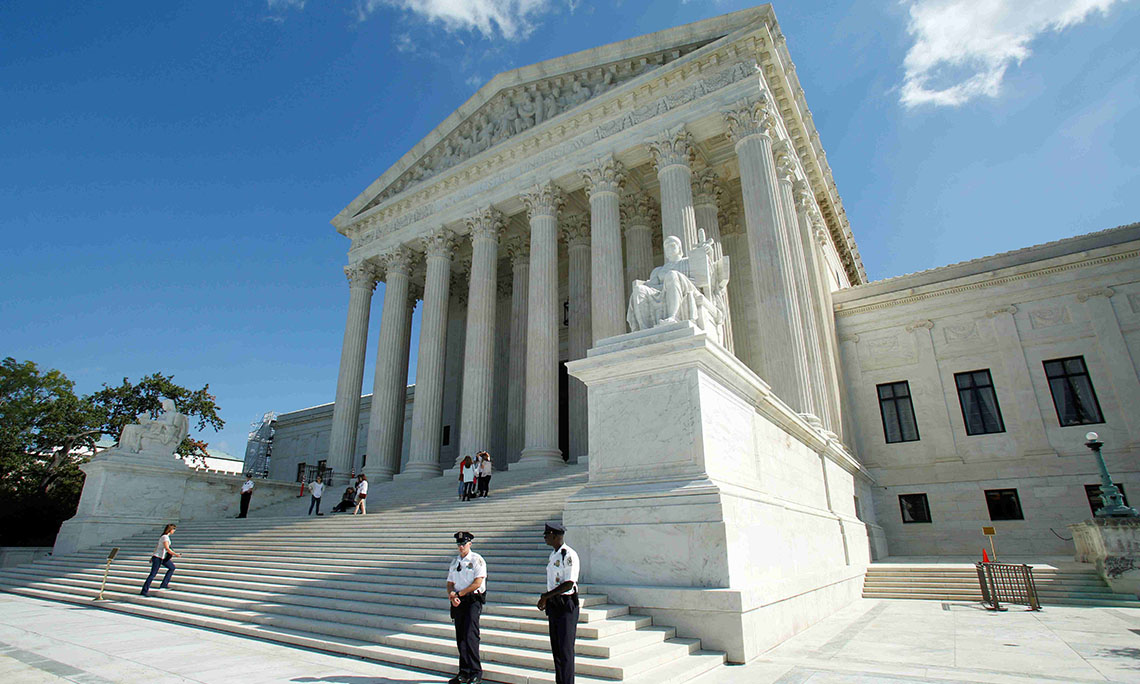
A Louisiana lawsuit now before the Supreme Court of the United States is drawing renewed attention to the growing use of litigation as a tool to advance climate policy, raising questions about fairness, forum shopping, and the balance between state and federal courts.
Former U.S. Attorney General Michael Mukasey, who also served as a federal judge in New York, discussed the case’s implications, arguing that it exemplifies a broader trend in which activist-driven lawsuits attempt to achieve regulatory outcomes through the courts rather than through legislatures.
The case centers on lawsuits brought by Louisiana parishes against oil companies over alleged coastal erosion, with damages claims reaching into the tens of millions of dollars. The companies argue that their activities date back to World War II-era federal contracts, when oil extraction in the region was undertaken at the direction of the federal government to support the war effort. Under state law enacted decades later, activities begun before 1980 were explicitly exempted from new permitting requirements, a point the companies say should shield them from liability.
Mukasey explained that after early court rulings appeared to recognize those exemptions, subsequent decisions reversed course, allowing the lawsuits to proceed in state court. The oil companies then sought to move the case to federal court under a long-standing statute that permits removal when federal interests are implicated, contending that state courts are subject to political pressures that make a neutral hearing unlikely.
At issue, Mukasey said, is whether cases tied to historic federal policy decisions can be fairly adjudicated in state courts where judges are elected and where local governments stand to gain financially from large damage awards. He noted that Louisiana has previously recovered erosion-related damages from the federal government itself and has now shifted blame to private companies for the same environmental effects.
The dispute reflects a wider pattern seen in other states, including Illinois, where certain jurisdictions have become magnets for large-scale civil litigation against deep-pocketed defendants. Critics argue that this environment encourages forum shopping and transforms courts into venues for policymaking, particularly on climate issues, rather than neutral arbiters of existing law.
Mukasey emphasized that the Supreme Court’s decision will not determine environmental policy itself, but could clarify whether federal courts must hear cases involving federal actions and contracts, even when plaintiffs prefer to litigate in state forums. Such a ruling, he suggested, would reinforce long-standing protections designed to prevent local bias from shaping outcomes in cases with national implications.
As climate-related lawsuits continue to proliferate across the country, the Louisiana case is being closely watched as a potential test of how far litigation can be used to retroactively impose liability for decades-old activities, and whether the federal judiciary will draw firmer boundaries around the practice of using courts as instruments of policy change.