




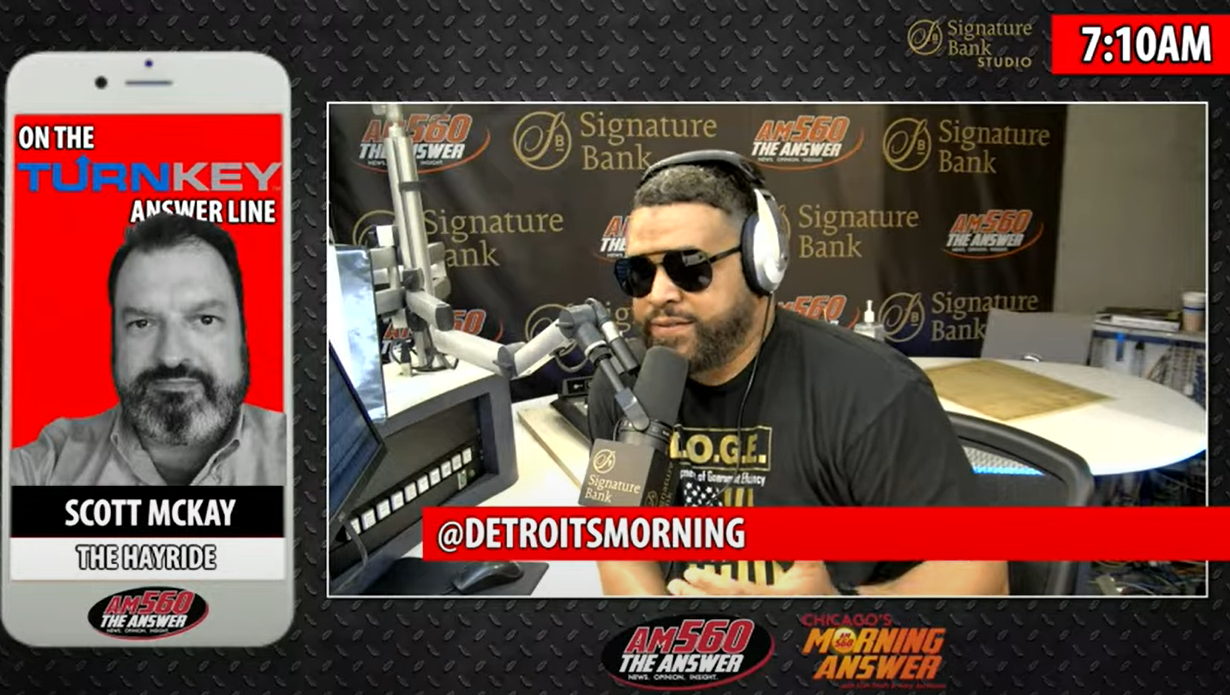
Guest host John Anthony’s conversation with The Hayride publisher and American Spectator senior editor Scott McKay on Chicago’s Morning Answer covered no shortage of cultural fireworks — from Hamas to Hollywood, victimhood to virtue, and even a country music controversy. But beneath the wit and wordplay was a serious warning: America’s core moral fabric is unraveling.
McKay joined Anthony to discuss his recent Spectator column, “The Moral Divide: It’s Good Versus Evil,” which argues that today’s political battles have crossed from the ideological into the spiritual. “When pro-Hamas crowds showed up at Israeli consulates on October 7 — the anniversary of the attacks — that was a defining moment,” McKay said. “You had people celebrating terror under the guise of activism. That’s not politics. That’s evil.”
McKay cited other examples that, to him, underscore a civilization slipping into moral inversion — from apologists downplaying the assassination of conservative activist Charlie Kirk (“They know they’re supposed to be upset, but they’re really not”) to what he called the “theater of victimhood” now embedded in modern politics and protest culture.
“This is what the Left has fully embraced,” McKay explained. “It’s all about provoking a reaction, playing the victim, and using that for moral leverage. Whether it’s Antifa spitting on ICE agents or Hamas hiding behind women and children, it’s all the same tactic: manipulate compassion to justify corruption.”
Anthony and McKay delved into the larger consequences of what McKay calls “victimhood culture” — the slow decay of honor-based values that once defined the West. “We used to be an honor society,” McKay said. “You didn’t spit on someone because you were angry — your own sense of honor wouldn’t allow it. But now, being a victim gives you social currency.”
He argued that the moral codes that guided civilization — from the Geneva Convention to simple chivalry — are collapsing. “When the fabric frays, it doesn’t stop. One day you’re sneering at a man for opening a door, and the next, you’re rationalizing the bombing of a hospital. Once honor disappears, civilization follows.”
Anthony drew the discussion back to the Middle East, noting that Hamas deliberately uses civilian structures for military purposes. McKay didn’t mince words: “Hamas didn’t build those hospitals and schools from tax revenue — they built them with Western aid money meant for humanitarian projects. They turned compassion into camouflage.”
The pair didn’t stay somber for long, though. Anthony asked McKay about his viral nickname for Democratic leader Hakeem Jeffries: “Teemu Obama.” McKay laughed, explaining that the term just fit. “He’s not a dollar-store Obama. Dollar stores are respectable businesses. He’s a Teemu Obama — looks good in the picture, but what you get in the mail is half the size and twice the disappointment.”
The conversation wrapped on a lighter note — or at least a musical one — as McKay weighed in on the controversy surrounding country artist Zach Bryan’s rumored anti-ICE lyrics. McKay speculated that the uproar might have been manufactured by record label PR tactics, but either way, he wasn’t buying it. “We’re not interested in artists trashing cops while Antifa’s out there trying to kill them. You pull that stunt, you’re the Cracker Barrel of country music.”
McKay’s advice for entertainers was simple: “If you’re talented, let your talent speak. Don’t shove your politics in everyone’s face. Michael Jordan figured that out decades ago — Republicans buy sneakers, too.”
As Anthony closed out the segment, both men shared mutual appreciation — and a few book plugs. McKay’s latest novel Blockbuster is earning rave reviews, while Anthony teased that his own book Letters to John Boy is being adapted into a film.
The hour may have ended with laughter, but McKay’s central warning lingered: when a culture trades honor for outrage and virtue for victimhood, the fall doesn’t come with a bang — it comes disguised as progress.