




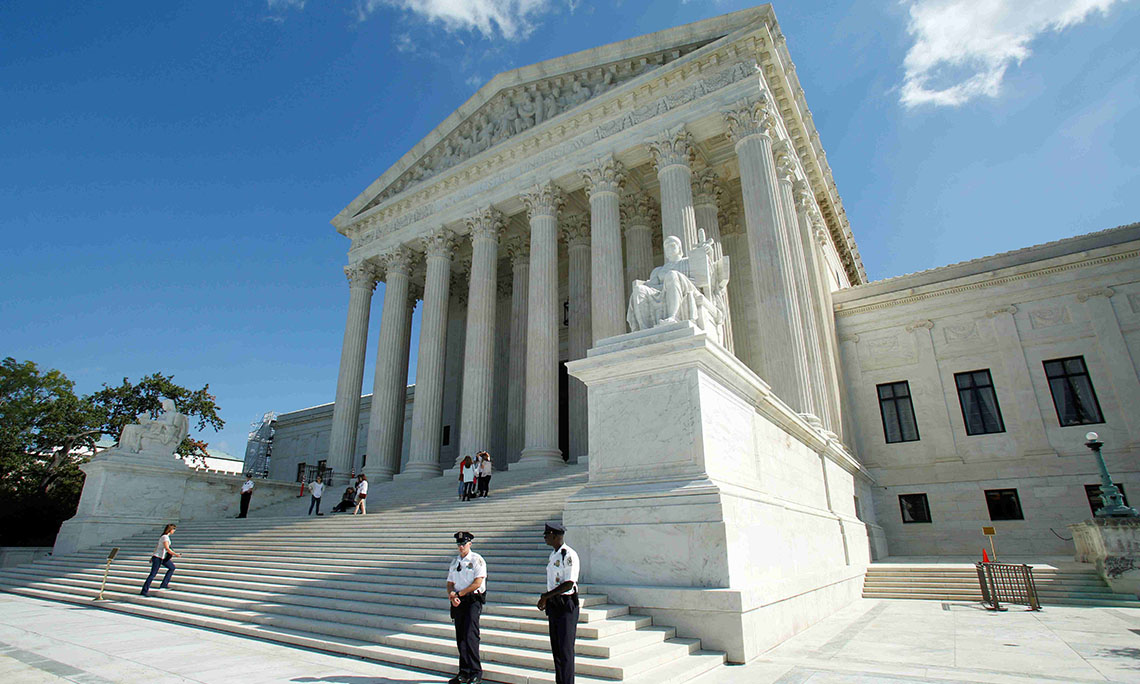
The Supreme Court this week heard oral arguments in a closely watched case that could reshape the limits of presidential authority over trade policy, and Cornell Law Professor William Jacobson joined Chicago’s Morning Answer with Dan Proft to break down the stakes. At issue is whether President Donald Trump exceeded his statutory authority when he unilaterally imposed sweeping tariffs on imported goods — a power the administration insisted was justified under emergency economic provisions, while challengers argue only Congress can levy taxes.
Professor Jacobson, founder of Legal Insurrection, said the outcome is far from predetermined and the arguments suggest a divided court. While no justice appeared to dispute that Trump properly declared a national emergency involving trade, the central question is whether tariffs used as foreign-policy leverage should be treated as regulatory tools or as taxes, which Congress alone has constitutional authority to impose. “This is a much closer call than media coverage suggests,” Jacobson noted, saying the debate turns on whether tariffs applied for diplomatic or strategic purposes fall outside traditional tax distinctions.
During arguments, justices from across the ideological spectrum pressed both sides. Chief Justice John Roberts raised concerns about executive power eclipsing Congress’s core taxing authority, while Justice Brett Kavanaugh challenged the notion that a president could legally ban all imports under emergency powers but not impose even a modest tariff. Jacobson said this “donut-hole” hypothetical weighed heavily: “Does it make any sense Congress would allow a total embargo but not a 1% tariff as a foreign-policy tool?”
The Court’s conservative bloc appeared divided, and Jacobson suggested Chief Justice Roberts could again seek a narrow path, similar to the court’s Obamacare ruling, possibly grounding the decision in alternate statutory authority rather than sweeping constitutional doctrine. If Trump prevails, the ruling could cement broad executive power over trade in emergency circumstances. If not, future presidents — including Trump himself — may face tighter constraints and require explicit congressional approval to use tariffs as geopolitical leverage.
Either way, Jacobson emphasized the case carries significance beyond Trump. With presidents of both parties increasingly relying on executive action in economic and national-security matters, the Court’s decision could reshape how the United States responds to global supply chain threats, trade disputes, and foreign coercion. “What seems likely,” he concluded, “is a ruling that defines — or limits — what regulate means in this context, and whether Congress clearly handed this authority to the executive. This is statutory interpretation at its core, but the consequences could be broad.”