




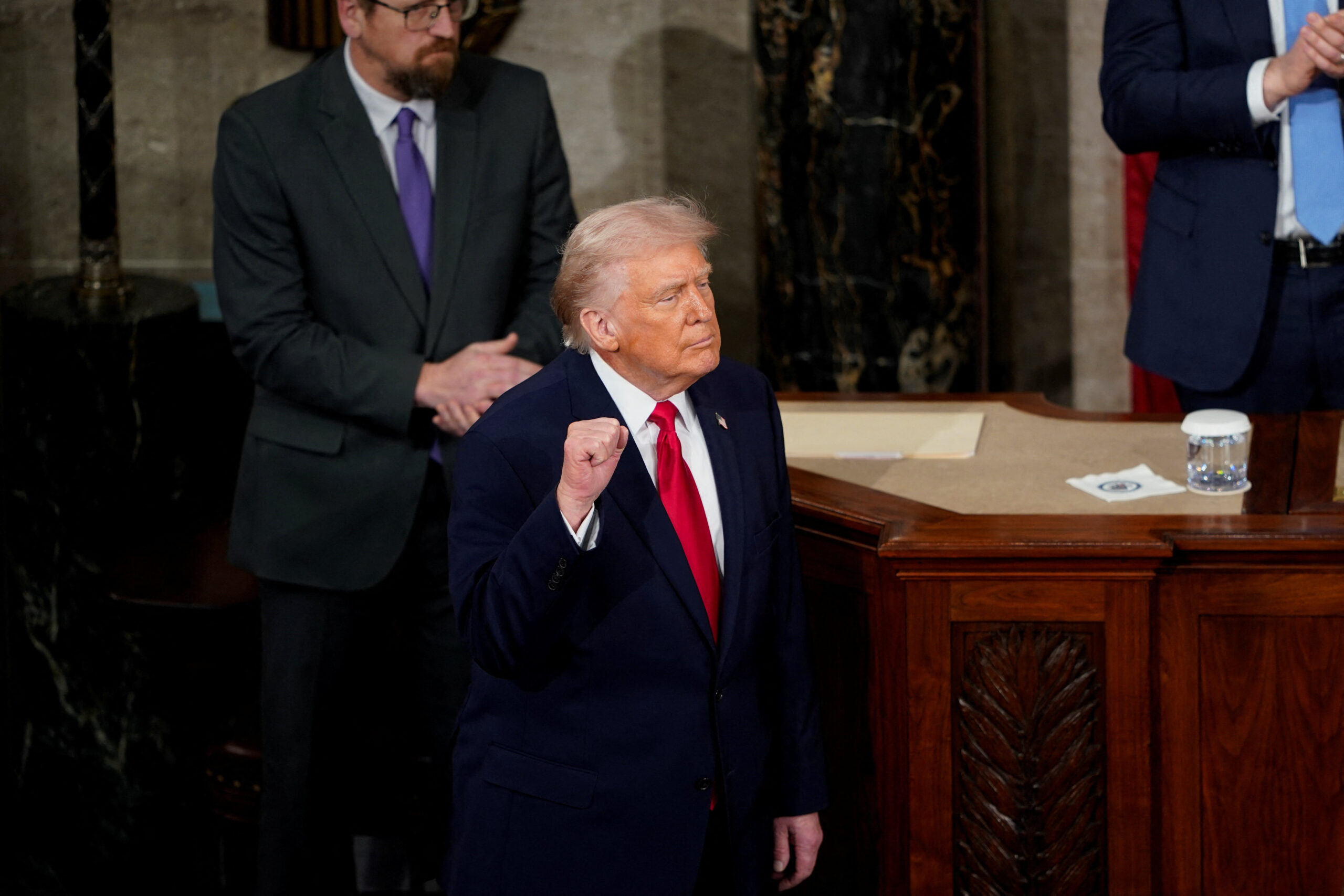
President Trump used his State of the Union address to defend tariffs as a cornerstone of what he called the nation’s “stunning economic turnaround,” but investors are still digesting the legal and economic uncertainty following a recent Supreme Court ruling that cast doubt on elements of his trade policy.
On Chicago’s Morning Answer, Dan Proft spoke with Jim Iuorio about how Wall Street is processing the latest developments and what they could mean for markets in the months ahead.
In his address, Trump argued that tariffs generated hundreds of billions of dollars in revenue, helped renegotiate trade deals, and strengthened the U.S. negotiating position globally. He criticized the Supreme Court’s recent ruling affecting certain tariff authorities but signaled that his administration would rely on alternative legal statutes to keep trade measures in place. Trump also floated the long-term idea that tariff revenue could eventually offset income taxes, easing the financial burden on American workers.
Proft noted that while tariffs can serve as leverage in negotiations, their broader fiscal impact remains limited relative to federal spending. With a federal budget of roughly $7.5 trillion, even hundreds of billions in tariff revenue would not come close to replacing income taxes absent dramatic spending cuts. There is also an unresolved question about previously collected tariffs and whether some funds may need to be refunded depending on lower court rulings. Companies including FedEx have already filed legal challenges seeking reimbursement.
Iuorio said the market reaction has less to do with the merits of tariffs and more to do with uncertainty. He pointed out that 2026 had been expected to bring greater clarity on trade policy, allowing corporations to make long-term investment decisions. The Supreme Court’s decision and the administration’s response, he said, temporarily disrupted that outlook.
Gold prices surged sharply following the ruling, a move Iuorio attributed to renewed global trade uncertainty and continued hedging against potential dollar instability. He emphasized that markets crave clarity, not necessarily a specific outcome.
On the broader economic picture, Iuorio remains cautiously optimistic. He cited tax policy changes, particularly immediate expensing of capital investments, along with deregulation and foreign investment commitments as potential tailwinds. While Trump has touted trillions in pledged investments, Iuorio said markets will look for tangible follow-through rather than headline figures.
At the same time, the labor market presents a mixed signal. Iuorio described it as soft but suggested that productivity gains from artificial intelligence and prior overhiring may be contributing factors rather than signs of structural weakness. If productivity improvements coincide with easing monetary policy, he believes risk assets could benefit.
He cautioned, however, that equity markets have already posted three consecutive years of double-digit gains, and midterm election cycles often bring volatility. The S&P 500’s recent struggles around the 7,000 level reflect investor hesitation pending concrete economic results.
The conversation also touched on sector rotation within equities. Iuorio said he has reduced exposure to large-cap technology stocks in favor of small-cap and domestically oriented companies, arguing that an improving U.S. economy could favor smaller firms more directly tied to domestic growth. While he remains bullish on artificial intelligence as a transformative force, he suggested that the biggest beneficiaries may ultimately be companies that effectively deploy AI rather than those that simply manufacture it.
Cryptocurrency markets were also discussed, with Iuorio noting that Bitcoin remains highly correlated with the NASDAQ, undermining its reputation as an uncorrelated hedge asset. He described recent declines as consistent with past volatility cycles rather than a sign of permanent decline.
As for Trump’s broader economic messaging, Iuorio said that while some proposals, such as government-backed investment accounts, may raise philosophical concerns about federal involvement, they could still produce positive outcomes in practice. Ultimately, he argued, markets will respond to measurable growth, stable trade policy, and clear fiscal direction rather than rhetoric alone.
For now, investors appear to be balancing optimism about potential deregulation and investment with caution over trade policy ambiguity. Whether the so-called “Trump boom” materializes may depend less on speeches and more on how quickly legal and policy questions surrounding tariffs are resolved.