




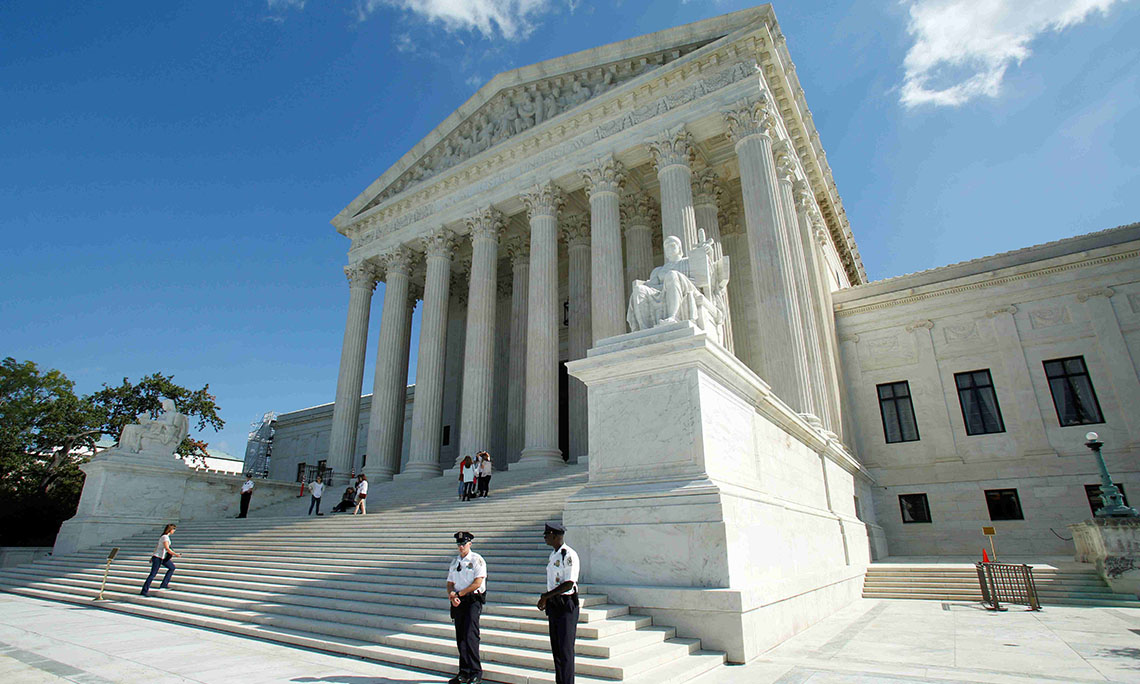
As the Supreme Court prepares to hear Trump v. Washington, the most consequential immigration case in decades, the future of birthright citizenship is suddenly in play. The political world is treating the moment as explosive; the legal world is treating it as overdue. And on Chicago’s Morning Answer, University of Tennessee constitutional scholar Morgan Marietta made the case that the debate is not only legitimate but unavoidable.
Dan Proft opened the discussion by noting that the modern immigration system—shaped largely by the 1965 Immigration and Nationality Act—has created mass inflows that Congress never envisioned. Former Trump adviser Stephen Miller recently argued that the “largest social experiment ever conducted on a civilization” has produced chronic assimilation failures and public-policy distortions in education, healthcare, and crime.
Proft underscored that the issue is not whether immigrants can assimilate, but whether the United States has maintained coherent criteria for who enters and under what expectations. That context, he argued, is inseparable from the looming fight over birthright citizenship.
The Constitutional Question: Who Decides?
Marietta stressed that when arguments turn emotional, the Constitution offers a colder corrective: it rarely tells Americans what to decide, only who gets to decide it.
“That’s what’s missing from the public conversation,” he said. “The 14th Amendment doesn’t mandate open borders or closed borders. It doesn’t mandate automatic birthright citizenship for everyone born here. It places the decision with Congress and the executive—the representatives of the American people.”
The hinge of the dispute is the amendment’s key phrase: “subject to the jurisdiction thereof.”
According to Marietta, the common claim that this simply means “physically located within U.S. territory” is ahistorical, inconsistent with the text, and incompatible with the amendment’s purpose.
“If it meant just geographic territory, the amendment would be repeating itself,” he explained. “Born in the United States and born in the United States. It has to mean something else—and it does.”
That “something else” is mutual political allegiance: a public acknowledgment from the individual and a reciprocal acceptance from the American people. This understanding was widely shared by the 14th Amendment’s authors and ratifiers in 1868.
Why Wong Kim Ark Isn’t the Shield Many Assume
Marietta argued that the most frequently cited precedent—United States v. Wong Kim Ark (1898)—does not resolve today’s dispute and is routinely misrepresented.
“That case dealt with the child of legal permanent residents,” he said. “It did not involve illegal migrants. It did not involve tourists. And it did not establish universal birthright citizenship.”
More strikingly, he said, the decision relied on British common law standards about subjects of the Crown—standards the Founders explicitly rejected when constructing a republic of citizens rather than subjects.
“British law treated anyone born on the soil as a subject because the king wanted more subjects,” Marietta said. “That logic is incompatible with American self-government. Citizens aren’t the property of a sovereign. They are members of a political community who decide for themselves who joins them.”
Another overlooked precedent, Elk v. Wilkins (1884), directly supports the idea that citizenship requires consent, allegiance, and lawful presence—and that unilateral claims of citizenship are invalid.
If the Court Follows the Constitution’s Original Meaning
Under an originalist reading—the interpretive approach currently dominant on the Court—Marietta believes the Constitution permits Congress to deny citizenship to children of illegal migrants and those engaged in “birth tourism.”
“This is the first time the Court will truly confront that issue,” he said. “The text and history are clear. The question is whether the justices will follow them.”
But will they?
Here Marietta’s analysis grew cautious.
He expressed little confidence that the Court’s conservative majority would hold. While Justices Thomas and Gorsuch are likely to adhere to originalist principles, Marietta warned that Chief Justice John Roberts, Brett Kavanaugh, and Amy Coney Barrett may flinch in the face of political pressure.
“I’m afraid a couple of the Republican appointees may not have the courage to withstand the emotional narratives,” he said. “This case is about who decides—not what is kind or unkind. But the Court may split 5–4 or even 6–3 against restricting birthright citizenship.”
What’s Really at Stake
Marietta emphasized that the 14th Amendment was written to secure citizenship for formerly enslaved Black Americans—not to bind future generations to immigration policies the framers never considered.
“It’s a mistake to treat the Constitution as if it already answered every modern question,” he said. “It answers the most important one: The American people are the decision makers.”
A ruling that clarifies that principle could reshape immigration policy for generations. A ruling that avoids it would leave current birthright citizenship practices intact, likely guaranteeing continued legal and political battles.
For now, Proft summed up the mood among originalist scholars: hopeful for clarity, wary of judicial timidity.
As Marietta put it, “The Constitution isn’t heartless or generous. It’s procedural. It tells us who has the authority to decide the future of American citizenship. Whether the Court honors that structure is the question of the moment.”
The Supreme Court will hear arguments later this term.