




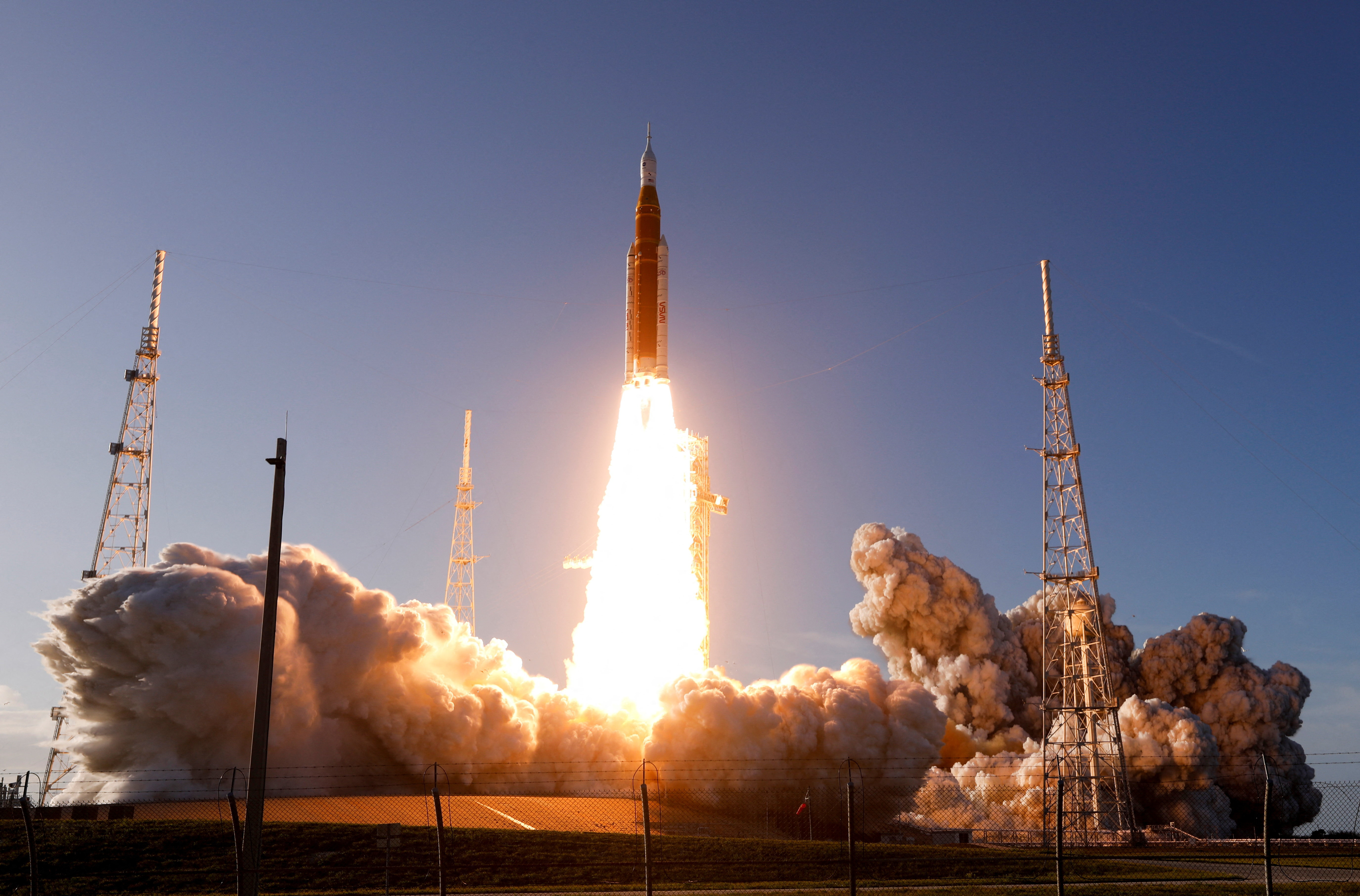
The Artemis 2 launch drew expressions of wonder from across the political spectrum Wednesday, uniting astronauts, politicians, and ordinary Americans in a moment of shared national pride that has been rare in recent years.
Michelle Nichols, senior director of public programs at Chicago’s Adler Planetarium, joined Dan Proft on Chicago’s Morning Answer to explain the mission’s significance and what comes next in NASA’s return to the moon.
Nichols said hundreds of people gathered at the Adler to watch the launch live, and that the atmosphere was electric, with staff and visitors jumping up and down, cheering, and in some cases crying. The four-person crew, consisting of three American astronauts and one Canadian, lifted off aboard the Space Launch System rocket, which Fox News reporter Jonathan Serrie described from the launch site as producing vibrations felt in the chest and flames as bright as the sun. The countdown included several last-minute technical issues, including a temperature anomaly on a launch abort system battery that was ultimately traced to a faulty instrument rather than the battery itself, and a communications problem with the flight termination system, which would be used to destroy the rocket if it went off course toward a populated area during ascent. Engineers resolved both issues and launched approximately ten minutes behind the original schedule.
The Artemis 2 mission will not land on the moon. Its purpose is to put the Orion spacecraft through its paces with a human crew aboard for the first time, testing systems, releasing small scientific satellites into high Earth orbit contributed by Argentina, Saudi Arabia, and Germany, and photographing the lunar surface during the flyby. Pilot Victor Glover was expected to take manual control of the spacecraft later in the day to test its handling characteristics. The mission’s trajectory takes the crew past the moon and potentially further from Earth than any human being has ever traveled, using what mission planners call a free return trajectory in which lunar gravity slowly curves the spacecraft back toward Earth for a Pacific Ocean splashdown off the coast of San Diego.
Nichols explained that the Artemis program is structured as a series of increasingly ambitious missions rather than an immediate return to lunar landing. Artemis 3, tentatively scheduled for 2027, will test the lunar landing hardware in Earth orbit. Artemis 4, targeted for 2028 if the preceding tests succeed, is planned to be the actual moon landing mission, which would be humanity’s first since the Apollo 17 mission in 1972, a gap of more than five decades. She said that going straight to a landing attempt after a fifty-three-year absence from the lunar surface would be inadvisable, and that the step-by-step approach reflects hard lessons learned from the history of human spaceflight.
The private sector is integral to the mission in ways that distinguish Artemis fundamentally from Apollo. NASA provides the Space Launch System rocket and the Orion spacecraft, but the lunar lander that will actually touch down on the moon’s surface is being developed by private companies through NASA contracts. Nichols said whichever company’s hardware proves ready and performs best in the 2027 orbital test, potentially more than one, will be the vehicle that carries astronauts to the surface in 2028. SpaceX and Blue Origin are among the companies involved in that competition, representing a public-private partnership model that has reshaped American space exploration over the past decade. The Orion spacecraft itself cannot land on the moon, requiring a separate purpose-built vehicle for the surface phase of the mission.
Nichols said the Adler has incorporated lunar programming throughout spring break, including hands-on art and science activities on the museum floor, a planetarium show called Imagine the Moon available for school groups and the general public, and on clear Wednesday evenings the pointing of the planetarium’s large public telescope at the moon, which she said looks spectacular through the instrument. The planetarium has also, she noted, added a Pink Floyd Dark Side of the Moon show to the rotation, on the grounds that moon exploration benefits from a little rock and roll.
On the longer-term vision of permanent lunar habitation and eventual public access to space travel, Nichols said the honest answer is that a lunar hotel remains a long way off, but that learning how to sustain human presence on the moon for weeks at a time, something never yet accomplished given that the longest Apollo surface stays lasted only a few days, is a necessary precursor. The current program, she said, represents exactly the kind of incremental steps required to eventually get there.