




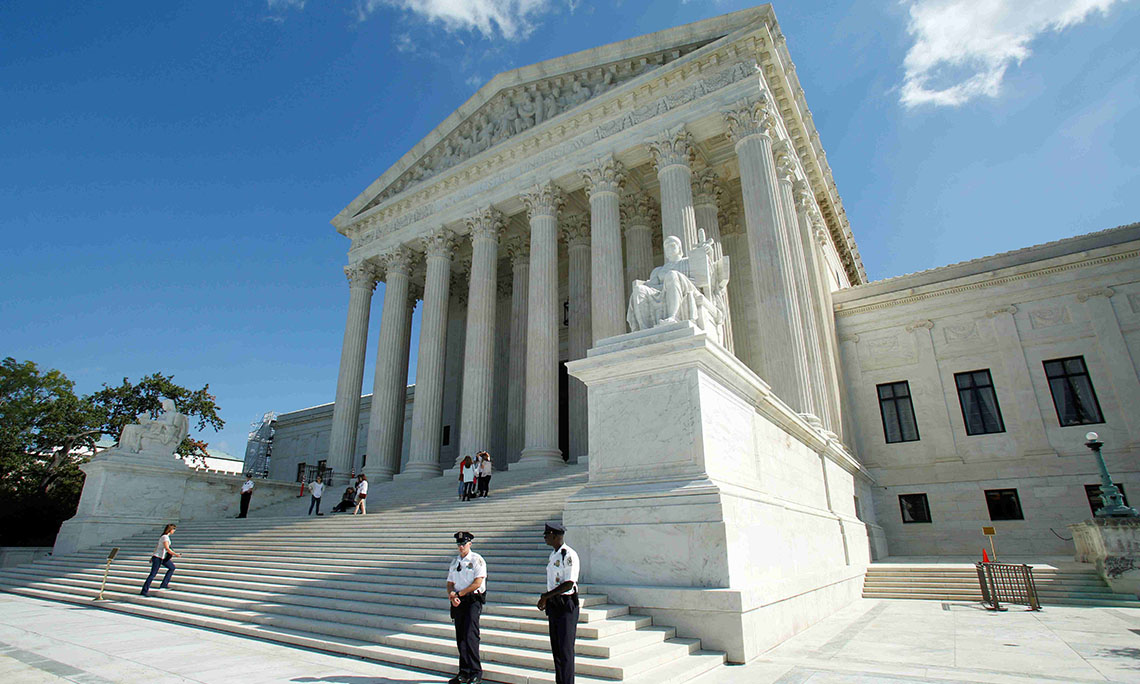
Three major leaks from the Supreme Court in four years, a pattern with no modern precedent for an institution historically defined by its secrecy, provided the backdrop for a conversation with University of Chicago Distinguished Service Professor Emeritus of Law Richard Epstein, whose new book The Myth of Birthright Citizenship publishes May 1st and whose analysis of the recent oral arguments produced a withering assessment of the constitutional reasoning on display from multiple justices.
Proft opened by sharing an account from Molly Hemingway’s new book on Justice Samuel Alito describing the internal atmosphere at the Supreme Court in the weeks surrounding the Dobbs decision. According to Hemingway’s sources, after the initial leak prompted protests at justices’ homes, threats of violence, and the attempted assassination of Justice Brett Kavanaugh, Justice Elena Kagan allegedly screamed at Justice Stephen Breyer not to accommodate requests from the majority to expedite the release of the dissent so the decision could be published and tensions defused. The dissenters then reportedly inserted a footnote referencing an undecided case into their opinion, which under court protocol prevented the Dobbs decision from being released for an additional three weeks. Fox News legal editor Carrie Severino noted that all three major Supreme Court leaks of the past four years have moved in the same direction, undercutting the conservative wing of the court, and that the Dobbs leak in particular coincided with real-world violence against pro-life organizations and physical threats against justices and their families.
Epstein said the breakdown in institutional comity on the court reflects a wider collapse of the reciprocal behavioral norms that make complex institutions function, tracing it back roughly twenty-five years to when Democrats began using the filibuster to block judicial nominees, establishing a pattern of non-cooperation that destroyed the informal understanding under which each party’s nominees received a fair hearing. Once that norm collapsed, the logic of pure obstruction became rational for both sides, and the court has not recovered. He said inserting a footnote to an undecided case specifically to delay publication of a decision whose authors are facing physical threats can only be described as dirty pool.
On the substance of the birthright citizenship arguments, Epstein was direct in his criticism of multiple justices across the spectrum. His core argument, developed at length in the new book, is that neither the lawyers arguing the case nor the justices questioning them adequately engaged with the naturalization statutes that are essential to understanding what the Fourteenth Amendment’s citizenship clause actually means. Epstein said he decided when writing the book that if he was going to address birthright citizenship seriously, he had better actually read the 1790 Naturalization Act, which he said he had never read in full despite decades of constitutional scholarship. The experience was, in his word, mindblowing.
The 1790 act establishes several principles that are directly relevant to the current dispute. It restricted naturalization to free white persons, a racial limitation that remained in effect for persons of African descent until 1872, years after the Fourteenth Amendment was ratified, which Epstein said illuminates what the framers of that amendment understood they were and were not changing. The act also consistently provided that the citizenship status of minor children follows the status of the parent, a principle Epstein said is black letter law that Justices Amy Coney Barrett and Ketanji Brown Jackson both violated when they tried to analyze the citizenship rights of children independently of their parents’ status during oral arguments. He said Barrett’s extended inquiry into whether a child could acquire domicile separately from its parents reflects a fundamental unfamiliarity with the settled law on that precise question, which is that a child’s domicile is determined by its parent’s domicile, full stop.
He was equally critical of Chief Justice John Roberts, who suggested at argument that the current birthright citizenship question represents novel circumstances without a historical precedent. Epstein said the Chinese Exclusion Acts of the 1880s and 1890s directly addressed the question of large-scale immigration and naturalization, and that every statute and treaty passed under that framework consistently precluded naturalization of individuals brought to the United States under those agreements. The circumstances are not novel. The precedents are simply being ignored.
He also challenged Roberts’s observation that it is the same constitution regardless of changing social circumstances, arguing that the constitution’s meaning has in fact changed significantly through judicial decisions over the past century and a half, most dramatically when the Supreme Court in 1885 announced in a single sentence that control over immigration is an inherent attribute of national sovereignty, effectively moving immigration authority from the states, where the original constitutional design had placed it, to the federal government, a transfer that was completed and fully preempted state authority by World War II.
On the separate question of the administration’s effort to rescind Temporary Protected Status for approximately three hundred and fifty thousand Haitians, Epstein said the president’s authority is substantial but not unlimited. If a prior administration’s grant of TPS was based on congressional authorization rather than pure executive discretion, Trump cannot simply override it. But to the extent the authority is purely executive, a subsequent president is not bound by his predecessor’s decisions. He said the immigration and naturalization framework gives the current administration vast discretion, and that while Trump’s particular policy choices may be politically controversial, they are not likely to be found unconstitutional within the existing doctrine the Supreme Court has developed over more than a century.