




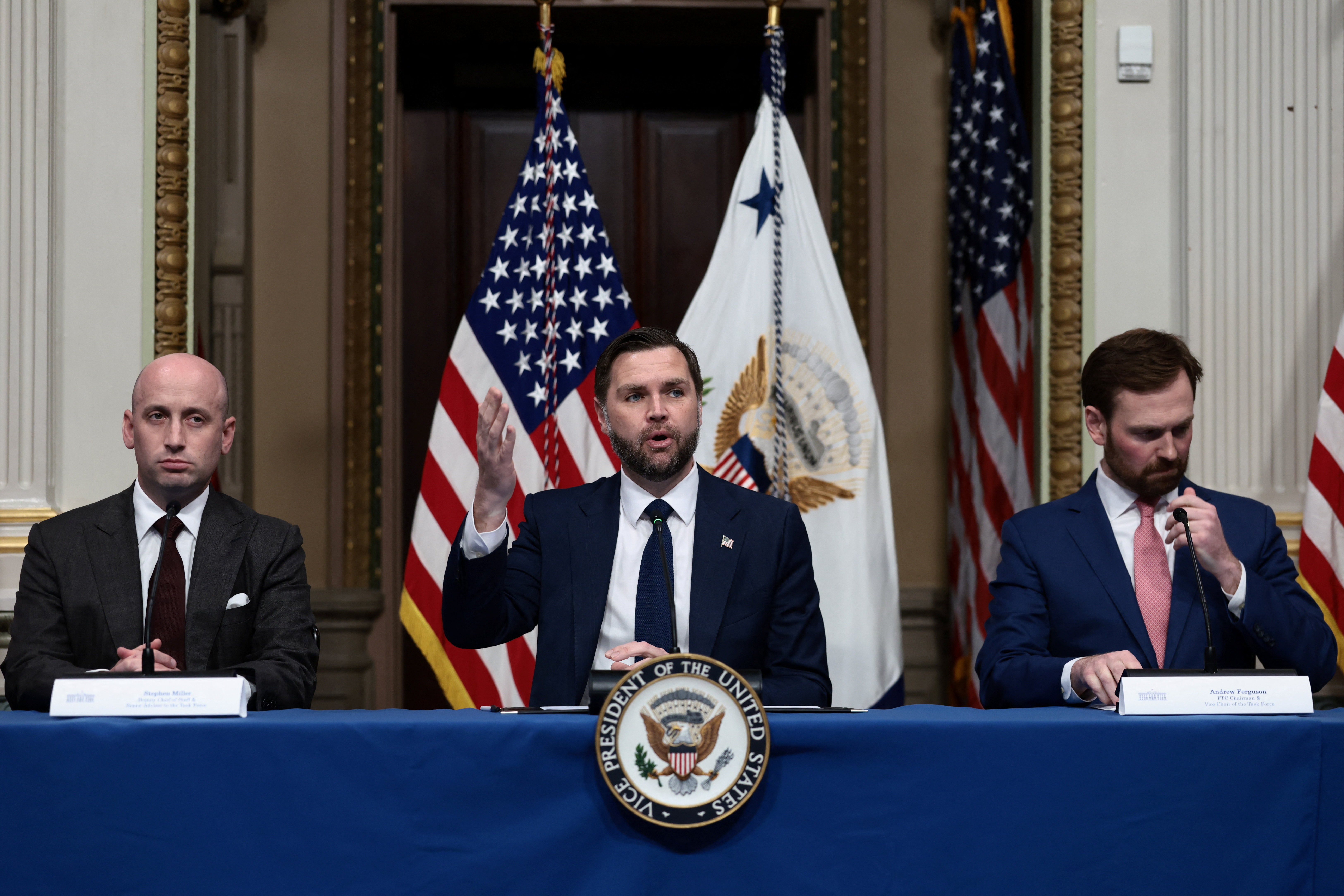
Vice President JD Vance held a press conference with Steven Miller and Assistant Attorney General Colin McDonald Tuesday to update the country on the anti-fraud task force’s progress, announcing referrals of over twenty-two billion dollars in fraudulent small business loans to Treasury for collection, deferrals of more than 1.3 billion dollars in fraudulent Medicaid reimbursements primarily from California, a six-month hold on new hospice and home healthcare provider enrollments after finding that many newer providers were not actually providing hospice services, recovery of funds from one hundred and thirty-five billion dollars stolen after COVID relief floodgates opened, identification of 6.3 billion dollars in suspected fraudulent government contracts mostly awarded under the previous administration, and the blocking of sixty million dollars in student aid fraud.
Andy McCarthy, former chief assistant US attorney for the Southern District of New York and contributing editor at National Review, joined Dan Proft on Chicago’s Morning Answer to assess the task force’s approach and discuss the broader structural questions the fraud epidemic raises.
McCarthy said he does not see how anyone can be against fraud prosecutions, but expressed concern about how the effort has been structured. He said the Justice Department has always had massive anti-fraud resources, and that the more important question, which he believes is better suited to congressional investigation than to the Justice Department itself, is whether there was a deliberate hands-off policy under the Biden administration toward program fraud in areas Democrats were politically invested in protecting. His concern with the current structure is that it leaves fraud prosecutions vulnerable to charges of political motivation, which defense attorneys will exploit in individual cases regardless of whether the underlying fraud is real and documented.
Proft noted that not a single Democratic state attorney general attended the task force press conference, despite being invited, with at most a few sending low-level representatives. McCarthy said Democrats are being politically disciplined in avoiding any appearance of collaboration with what they intend to characterize as a corrupt and politicized operation. He said this is about electoral messaging rather than any genuine assessment of the fraud, and that if Democratic attorneys general actually cared about program fraud, there would not be as much of it as there is.
He said the more fundamental point the episode reveals is that the federal government should exit the business of public welfare benefits entirely. He said if California wants to provide lush benefits, extend them to people in the country illegally for progressive political reasons tied to climate policy and social causes, and decline to police eligibility, that should be California’s right. What California should not be permitted to do is socialize the cost of that choice onto the rest of the country through federal matching funds and federal program participation. He said the Republican Party needs to wrestle seriously with these foundational questions about what the federal government should and should not be doing rather than simply chasing down individual fraudsters while leaving the structural conditions that generate fraud in place. He noted that with the federal government paying more in interest on the debt than it spends on defense, and running two and a half to three and a half trillion dollar deficits as far as the eye can see, the underlying fiscal trajectory cannot continue indefinitely regardless of how aggressively fraud is prosecuted.
On the administration’s creation of an 1.8 billion dollar anti-weaponization fund to compensate people wronged by their government, McCarthy said he views it as a political abuse of power rather than a legal one, drawing a distinction Proft challenged. He said some of the most serious forms of government misconduct simply cannot be prosecuted, and that the same judgment fund the administration is now proposing to use for this purpose is the same fund Obama used to make payments to Iran on false pretenses to close the JCPOA, conduct that was a profound abuse of power but entirely beyond criminal prosecution. His specific objection to the current fund is that Trump is using executive branch resources to compensate people who were harmed during Trump’s own watch, making it essentially a political operation by the executive to pay off people it likes. He said courts should generally stay out of this kind of intra-executive dispute.
Proft pushed back, arguing that given how thoroughly federal employees have been insulated from accountability for documented misconduct, how difficult existing legal avenues are for ordinary citizens harmed by government overreach, and how badly the government has behaved across multiple administrations, the fund represents a rebalancing of the power relationship between the state and the citizen that has some merit regardless of the structural concerns. McCarthy said people with legitimate claims do have legal avenues available to them, but acknowledged the core tension in his position: the rationale for the fund is to remedy political abuse of government power, while the Justice Department is simultaneously using government power against Trump’s political enemies, making the claim that the fund is a principled corrective rather than a political instrument difficult to sustain credibly.