




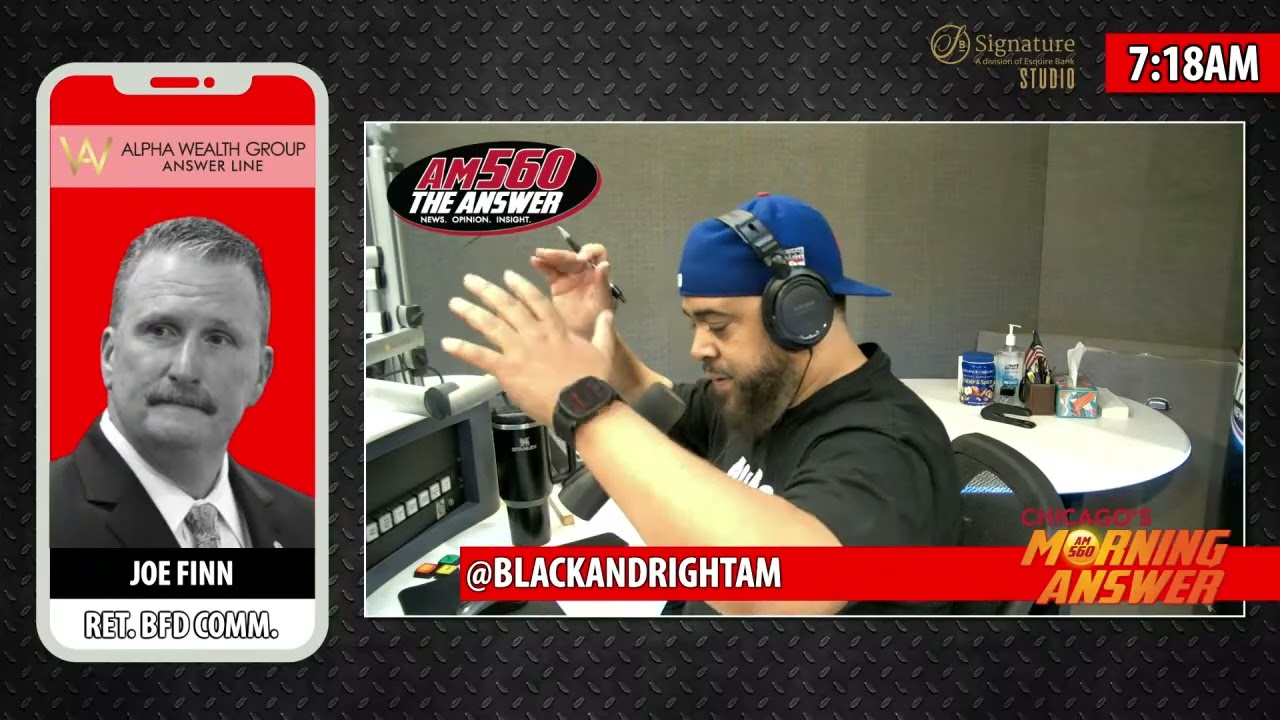
Former Boston Fire Commissioner Joe Finn is advocating for new technology that could give firefighters and police officers a critical advantage when they become trapped, injured, or lost inside dangerous buildings.
Finn, who spent 36 years with the Boston Fire Department and rose through the ranks before serving as fire commissioner and chief of department from 2014 to 2020, joined Chicago’s Morning Answer with John Anthony to discuss the effort. A former Marine Corps veteran, Finn has focused much of his career on firefighter safety, training, equipment and cancer prevention. He is now working to promote the Find Me Now initiative, which aims to bring precise 3D location technology to the fireground.
The technology could allow incident commanders to pinpoint the location of firefighters, police officers and even 911 callers inside structures, where traditional GPS often cannot provide an accurate location.
Finn said the technology could have made a difference during a deadly 2014 fire on Boston’s Beacon Street. Two Boston firefighters entered the basement of a large building during a high-wind fire in the city’s Back Bay neighborhood. After an event believed to have been a backdraft or flashover, the firefighters became trapped.
The challenge for rescuers was determining exactly where the two firefighters were located inside the large basement area. Crews attempted searches from both the front and rear of the building but were unable to immediately locate them.
Finn said technology capable of precisely identifying their location could have allowed commanders to direct rescue crews to the firefighters rather than conducting searches without knowing exactly where they were.
That ability, he argued, could be especially valuable in large structures, high-rises, warehouses and other environments where walls, floors and other obstacles prevent conventional GPS from providing reliable indoor positioning.
Find Me Now uses 5G-based technology to provide precision location information. Finn said the goal is to eventually have the technology incorporated into equipment that firefighters and police officers already use, such as self-contained breathing apparatus or radios, allowing a signal to be transmitted back to incident command.
The technology could also have applications beyond the fire service. Finn pointed to active-shooter situations in which a police officer may be wounded inside a large building and fellow officers need to know the precise location of the injured officer. Knowing where first responders are operating could also help commanders avoid dangerous situations, including potential friendly-fire incidents.
Finn and other supporters are seeking action from the Federal Communications Commission to establish the rules and policies needed to implement the technology. He said the initiative is attempting to build grassroots support among firefighters, police officers, 911 operators and public-safety leaders.
Anthony noted the apparent contradiction that consumers can track packages and luggage with remarkable precision while first responders inside dangerous buildings can still be difficult to locate.
Finn said the stakes are particularly high when a firefighter becomes trapped following a flashover or backdraft. Precise location information could give an incident commander another tool to deploy a rapid intervention team and attempt a rescue.
Finn also addressed another major threat facing firefighters: occupational cancer.
He called cancer the number one killer of firefighters and pointed to the increasingly toxic environments in which modern firefighters operate. Household products containing plastics and flame retardants can release highly toxic gases when they burn, exposing firefighters to carcinogens during emergency operations.
Finn also noted that certain chemicals, including PFAS, were historically used in firefighter protective gear. He said firefighters have faced unnecessary exposure to hazardous substances through both the environments they enter and some of the equipment designed to protect them.
Boston’s experience illustrates the scale of the problem, according to Finn. He said more than 250 Boston firefighters have died from occupational cancer over roughly the past 35 years, a figure he described as staggering. He suggested Chicago’s numbers over a similar period could be roughly twice as high.
Finn said the fire service needs to continue examining ways to reduce those exposures while also giving firefighters the best available technology to survive emergencies.
He urged firefighters, police officers, 911 operators and members of the public to support Find Me Now and help push the technology through the FCC process. Finn said supporters need to address questions about interference and coexistence with existing technologies rather than allowing potential corporate concerns to prevent the technology from being considered.
Chicago, Finn said, could play an important role in that effort. He praised the Chicago Fire Department as one of the best in the country and noted the longstanding relationship between the Boston and Chicago fire departments.
For Finn, the central argument is straightforward: when firefighters and other first responders enter dangerous situations to save lives, commanders should have every available tool to bring them home safely.