




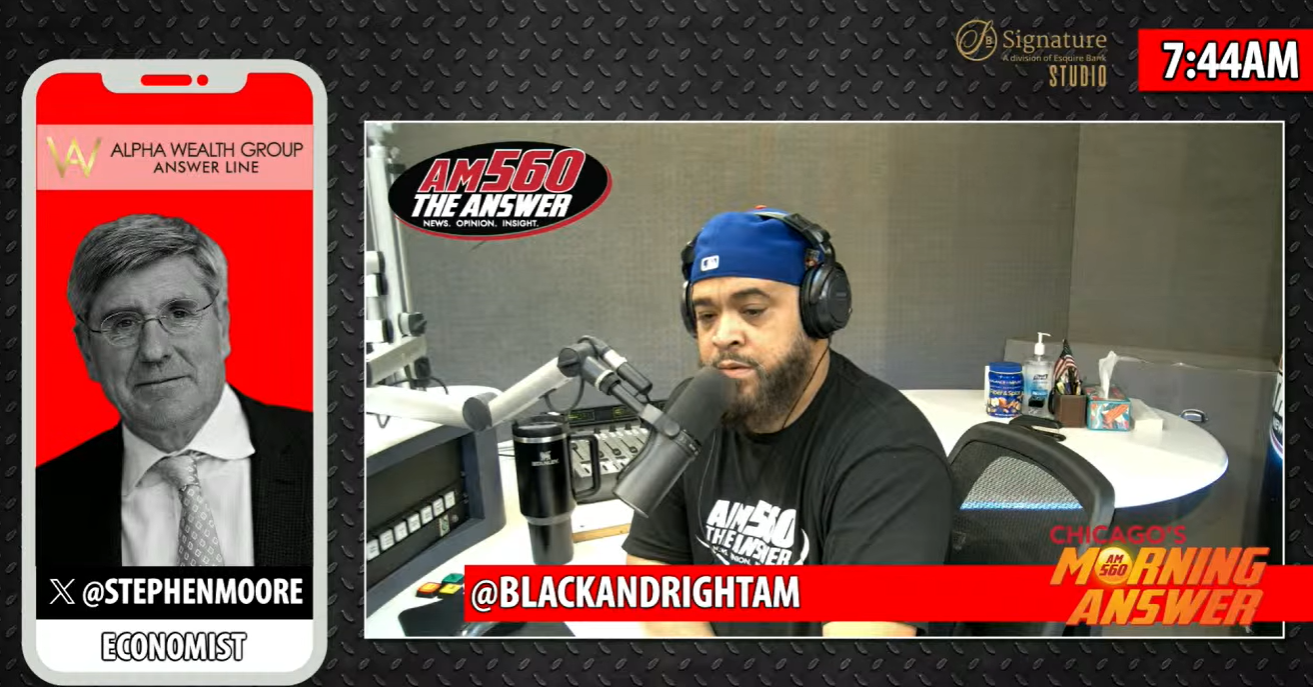
Economist Stephen Moore says the U.S. economy remains fundamentally strong despite widespread frustration over inflation, high living costs and uncertainty about the country’s economic future.
Moore, chairman and co-founder of Unleash Prosperity and a former Wall Street Journal editorial board member, joined Chicago’s Morning Answer with John Anthony to discuss the state of the economy, federal spending, energy prices, data centers and the policies he believes are necessary to keep the United States economically competitive.
Moore gave the current economy a “B,” acknowledging that many Americans would likely grade it much lower. He pointed to weak consumer confidence and frustration over the cost of groceries, housing and other necessities as reasons people remain pessimistic even as broader economic indicators show strength.
According to Moore, the United States continues to have significant advantages over other countries, including strong investment, technological innovation and a labor market with more job openings than people looking for work. He argued that the country remains the world’s dominant economy despite the challenges facing American households.
Inflation, however, remains a major source of frustration. Moore said the high cost of food and other everyday expenses is something he sees in his own family as well, arguing that strong economic statistics do not necessarily make rising prices feel any less painful for consumers.
Moore credited the Trump tax cuts with having a significant positive impact on the economy but said the biggest obstacle to stronger growth is what he described as out-of-control federal spending.
He also warned about the growing popularity of socialism within the Democratic Party, arguing that policies built around larger government and greater government control would ultimately undermine economic growth and individual freedom.
The conversation turned to recent economic growth figures, with Anthony noting that second-quarter GDP growth came in at an annualized 1.5%, while consumer spending and private business investment remained relatively strong.
Moore argued that the headline GDP figure does not tell the entire story. He pointed to a more optimistic forecast for the following quarter and said he expects the economy to accelerate.
Moore attributed much of the recent slowdown to higher energy prices connected to the conflict involving Iran. He explained that oil prices affect virtually every part of the economy because energy is incorporated into the production and transportation of goods.
If energy markets stabilize and oil begins flowing more freely, Moore said he expects the broader economy to benefit.
He also made the case for continued investment in data centers, which he described as an essential component of America’s technological infrastructure and a critical part of the competition with China over artificial intelligence.
The rapid expansion of data centers has generated controversy in communities concerned about water usage, electricity demand, noise and other impacts. Moore acknowledged that local residents have legitimate concerns but argued that communities should weigh those concerns against the economic and technological benefits.
He pointed to the jobs and investment generated by data-center construction and warned that states that reject such projects could lose them to other parts of the country.
Moore also argued that data centers are fundamental to the technology Americans use every day. Smartphones, internet services and GPS systems all rely on massive computing and data infrastructure, he said, comparing opposition to data centers to wanting electricity while rejecting power plants.
The competition with China, Moore said, makes the issue particularly important. He argued that the United States needs to maintain its technological advantage and suggested that Chinese interests benefit if Americans become reluctant to build the infrastructure necessary for artificial intelligence and other advanced technologies.
Moore said the country can maintain its technological leadership through lower taxes, reduced regulation, expanded energy production and policies that encourage investment and entrepreneurship.
Energy prices could also have political consequences. Anthony noted that gasoline prices remain a concern for voters, and Moore said Republicans could face significant political consequences if high gas prices persist into the upcoming elections.
Moore argued that voters ultimately judge economic policy based on what they experience at the kitchen table. If gasoline, groceries and other necessities remain expensive, broader claims about economic growth may not resonate with families.
Despite those concerns, Moore remained optimistic about America’s long-term economic prospects. He pointed to the country’s history of innovation and entrepreneurship and said the United States has the resources and human capital necessary to remain the world’s economic superpower.
Moore said the basic solutions to the country’s economic challenges are already well understood. He called for lower taxes, less regulation, greater economic freedom and an immigration system that allows the country to attract talented people from around the world.
His broader message to Republicans was that maintaining American economic dominance requires keeping the government from unnecessarily interfering with the private sector.
For Moore, the question is not whether the United States knows how to generate prosperity. The country already has a proven formula, he argued. The challenge is finding the political will to put those policies into practice.