




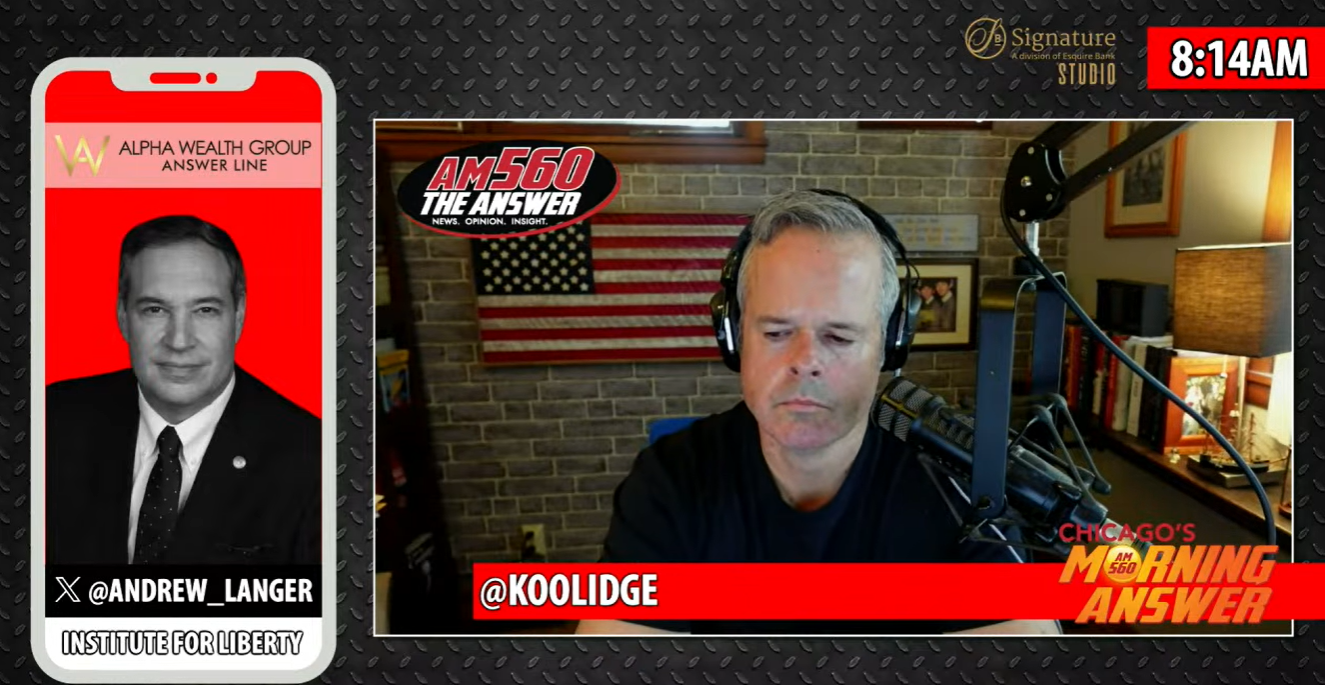
As Republicans begin looking beyond the Trump era, a debate is emerging over what the party’s economic philosophy should look like—and Institute for Liberty President Andrew Langer is warning conservatives against embracing a more interventionist approach.
Langer joined Chicago’s Morning Answer with Mike Koolidge, who was filling in for Dan Proft, to discuss his recent Wall Street Journal piece, “What JD Vance Gets Wrong About Hamilton,” and the growing debate within conservative circles over the proper role of government in the economy.
Langer said there is plenty to like about Vice President JD Vance, but he is concerned by Vance’s comments suggesting a preference for the economic philosophy of Alexander Hamilton over the free-market principles associated with economist Milton Friedman.
The distinction, Langer explained, comes down to the role government should play in directing economic activity. Hamilton favored a stronger, more centralized government and policies that encouraged government intervention in the economy. Friedman, by contrast, championed free markets and limited government interference, arguing that individuals and businesses generally make better economic decisions when government allows them the freedom to do so.
Langer said that distinction matters as Republicans prepare for the post-Trump political environment. He argued that conservatives have spent decades making the case that excessive regulation and government intervention can hinder economic growth by limiting the choices available to individuals and businesses.
He pointed to regulatory budgeting, an idea previously discussed by Secretary of State Marco Rubio, as an example of the more traditional conservative approach. The concept focuses on measuring the economic costs imposed by regulations and ensuring that government rules do not unnecessarily interfere with economic activity.
For Langer, the debate isn’t simply academic. He believes it represents a fundamental question about what Republicans stand for.
Langer also expressed concern about Vance’s discussion of establishing “Christian guardrails” for society. While acknowledging the importance of a moral and responsible culture, Langer questioned whether government should be in the business of defining and enforcing moral values.
He warned that government power used to impose one group’s values can eventually be wielded by political opponents to impose very different values. The concern, he said, is not limited to who controls the government today but what powers Republicans create that future administrations could use.
Langer described himself as closer to the philosophy of James Madison and Thomas Jefferson, emphasizing limited government and individual rights. He said government has an important role in protecting those rights but should ultimately empower Americans to make decisions for themselves rather than make those decisions on their behalf.
The discussion brought the familiar economic example of a pencil into the conversation. Koolidge referenced Milton Friedman’s famous explanation of how something as simple as a pencil requires an enormous network of voluntary economic activity, involving materials and workers from different places and industries.
Langer agreed with the broader lesson: no central authority needs to design the entire process for the economy to function. Individuals and businesses pursuing their own interests can coordinate through markets in ways that would be extraordinarily difficult for a government bureaucracy to replicate.
He pointed to a video produced by the Competitive Enterprise Institute based on Leonard Read’s classic essay “I, Pencil” as another illustration of the same principle.
Langer argued that the debate over government intervention will become especially important during the upcoming elections. He characterized the broader political conflict as one between socialism and capitalism, as well as between statism and individual rights.
That means Republicans need to offer voters a clear alternative to the policies of the Democratic Party, he said, rather than simply presenting a slightly less interventionist version of the same government-centered approach.
Langer argued that Republicans cannot consistently win by becoming “Democrat light.” Instead, he said, voters need to see a meaningful philosophical distinction between the parties.
He cited past presidential campaigns as examples of what can happen when candidates fail to establish a clear contrast with their opponents. According to Langer, John McCain struggled to explain how his approach to the 2008 financial crisis would differ substantially from Barack Obama’s, while Kamala Harris failed to clearly distinguish her potential policies from those of President Joe Biden during the 2024 campaign.
The discussion also touched on Trump’s record on regulatory policy. Langer said the Trump administration’s reduction of regulatory costs during Trump’s second term represents a significant achievement that has received relatively little attention.
According to Langer, regulatory costs were reduced by about 5% during the first year of Trump’s second term, which he described as unprecedented. He estimated that the direct savings amounted to roughly $200 billion.
Langer emphasized that the impact of regulations extends beyond their direct financial costs. When government requires businesses or individuals to take certain actions, he argued, it also eliminates choices and creates opportunity costs that can be much larger than the initial price tag of the regulation.
Reducing those costs, in his view, does more than save businesses money. It returns decision-making power to individuals and gives entrepreneurs greater freedom to determine how they operate.
Langer said that should be central to the Republican message moving forward: empowerment rather than government direction.
With the 2028 presidential race already beginning to take shape, the argument over the future of conservative economics is likely to become more prominent. Potential Republican contenders—including Vance, Rubio and others—could face increasing pressure to explain not only what policies they support, but what economic philosophy will guide those policies.
For Langer, the answer should remain rooted in limited government, individual liberty and free markets. He believes Republicans can build a durable political coalition by giving Americans greater control over their own economic decisions rather than expanding Washington’s role in making those decisions for them.
The debate over Hamilton versus Friedman, in other words, is ultimately a debate over a much larger question: whether the Republican Party’s future will be defined by government intervention or by the traditional conservative promise of economic freedom.