




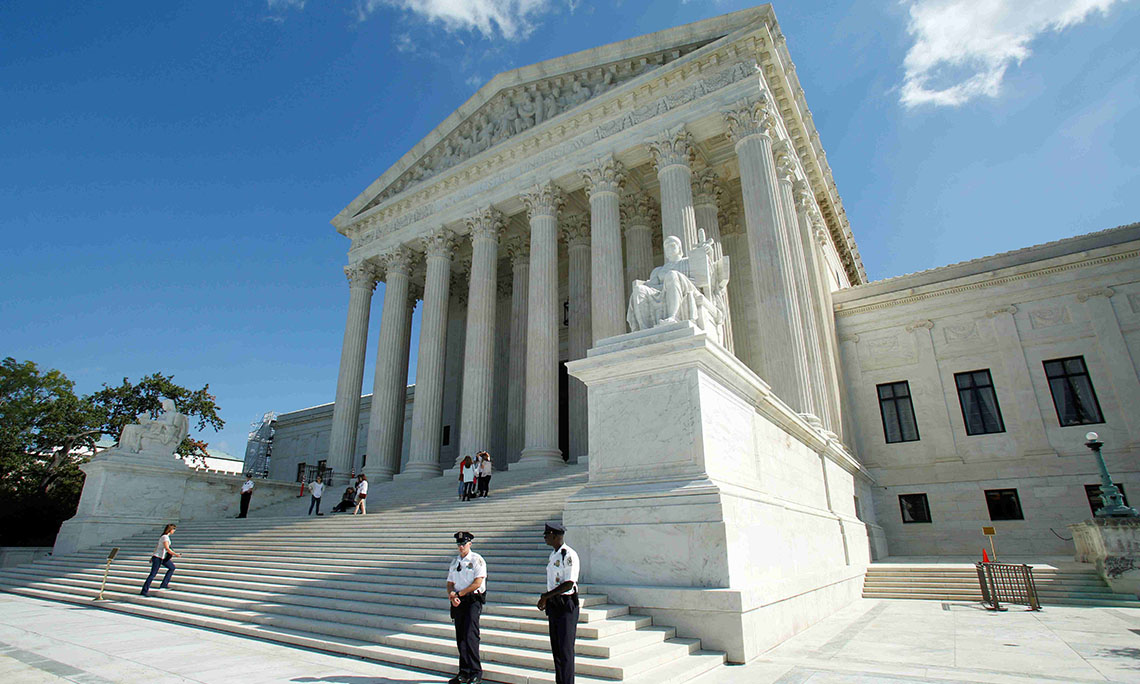
The Supreme Court’s recent decision in the Learning Resources tariff case has reignited debate over the limits of presidential authority in trade policy, with constitutional scholar Richard Epstein sharply criticizing what he described as an expansive and legally unsound use of emergency powers by the executive branch.
Epstein, the James Parker Hall Distinguished Service Professor Emeritus of Law at the University of Chicago, told Dan Proft that the statutory authority invoked by the Trump administration does not come “within a country mile” of authorizing the sweeping tariff regime initially imposed.
The case centers on whether the president properly relied on the International Emergency Economic Powers Act, commonly known as IEEPA, to justify broad tariffs. The Supreme Court issued a narrow ruling remanding the matter to a lower court, declining to directly address whether tariff revenues collected under the policy must be refunded. Administration officials have since pointed to other statutes, including provisions from the Trade Acts of 1962 and 1974, as alternative sources of authority.
Epstein rejected that reasoning, contending that the language of IEEPA does not explicitly authorize tariffs and that reading such power into the statute requires ignoring the broader context of its text. He also challenged the administration’s reliance on Section 122 of the 1974 Trade Act, which allows temporary tariffs to address “large and serious” balance-of-payments deficits.
“We’ve always had deficits,” Epstein said, arguing that the statutory threshold implies a destabilizing crisis rather than a routine trade imbalance. In his view, invoking emergency powers absent an independently verified crisis stretches the law beyond its intended scope.
The discussion touched on divisions among the justices, including concurring and dissenting opinions that addressed the non-delegation doctrine. Justice Clarence Thomas suggested that Congress may delegate certain foreign commerce powers to the executive without violating constitutional limits. Epstein dismissed that interpretation, insisting that while delegation is permissible, it must remain tethered to clearly defined statutory constraints.
Dan Proft countered that Congress has granted the president some authority over tariffs and that the statutory language gives the executive broad discretion, at least for limited periods. Epstein responded that discretion is not unlimited and that emergency powers cannot be triggered solely at the president’s declaration without objective criteria.
The conversation also explored whether courts should grant deference to executive interpretation. Epstein argued that deference depends on good faith statutory interpretation and that, in his view, the administration’s approach undermines that presumption.
Beyond the legal questions, Epstein criticized the broader economic rationale behind the tariff policy, stating that trade deficits do not constitute an emergency and that free trade has historically supported American prosperity. He suggested that using emergency authorities to restructure trade relationships reflects policy frustration rather than statutory necessity.
Proft acknowledged his own general support for free trade but emphasized that the immediate dispute concerns statutory interpretation rather than economic theory.
The Supreme Court’s remand means the lower courts will now revisit key questions, including whether collected tariff revenues must be returned and whether the administration’s reliance on alternative statutory provisions is legally sustainable.
As the litigation continues, the case underscores an enduring constitutional tension: how far Congress may delegate economic authority to the executive branch, and under what conditions emergency powers can be invoked in the realm of international trade.