




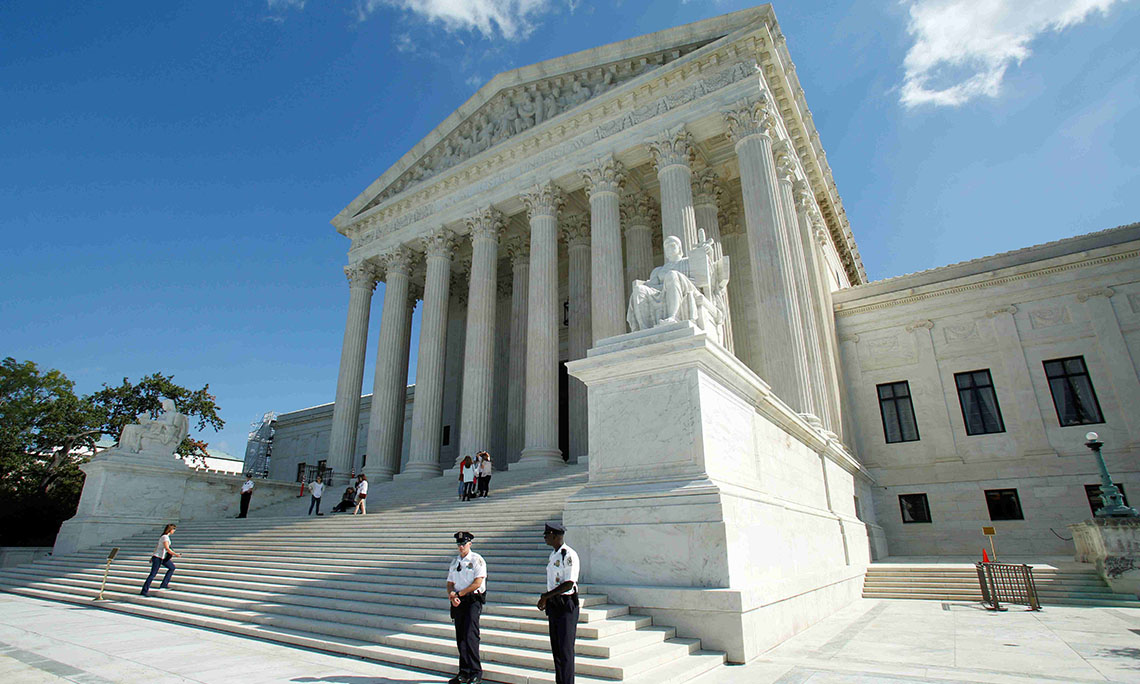
The Supreme Court handed the Trump administration two significant immigration victories this week. In a six-to-three decision, the court held that the administration has discretion to end Temporary Protected Status for immigrants whose home countries were previously deemed unsafe due to natural disasters or armed conflict, with Justice Clarence Thomas writing in his concurrence that aliens have no equal protection rights against the federal government. In a separate ruling, the court held that someone seeking entry to the United States without proper legal status and standing across the border in Mexico is not deemed to have arrived in the country, meaning the law neither entitles such a person to apply for asylum nor requires an immigration officer to inspect them.
S.A. McCarthy, the George Neumayer fellow and contributing editor at the American Spectator and writer at the Washington Stand, joined Dan Proft on Chicago’s Morning Answer to discuss what these rulings mean in the broader context of what he describes as a rapidly closing window of opportunity on immigration.
McCarthy said the combination of weakened mainstream media control over information, the transparency of social media, and the Trump administration’s willingness to act has exposed the scale of damage mass immigration has done to the country and created genuine political momentum for the mass deportation program Trump promised. He said this window will not remain open indefinitely, and the consequences of failing to act while it is open are visible in real time across Western Europe, where governments that refused to address unfettered immigration from the developing world are now watching their populations respond with increasing violence. He said the United States has an opportunity to address the crisis in a manner that is humane, safe, legal, and commendable, but if it fails to do so, more drastic measures will eventually be required.
On the DSA-aligned candidates who won New York primaries this week, most of whom are Muslim and several of whom hold explicitly anti-American positions, McCarthy said the dynamic functions as both a carrot and a stick for immigration enforcement. The rise of candidates like those elected Tuesday and figures like New York City Mayor Mamdani, who was born in Uganda, illustrates Trump’s warning that importing the Third World means becoming the Third World. He said the more the country imports populations with no shared cultural background, no familiarity with American legal and religious founding principles, and no concept of the norms and standards that define American society, the more those populations will vote to reshape the country in ways fundamentally incompatible with its existing character. Addressing immigration and addressing the electoral consequences of decades of failed immigration policy are intimately linked, he said, and you cannot solve one without solving the other.
On Republican figures like Ohio Governor Mike DeWine and New York Congressman Mike Lawler who have argued for extending TPS for Haitians on the grounds that they fill critical jobs in healthcare and other industries, McCarthy said the response depends on how one defines the nation. If America is nothing more than a GDP figure and a labor market, then the argument for keeping migrants to fill jobs is perfectly logical. If the nation is defined by its people, its principles, its culture, its history, and its founding ideals, then enduring some economic hardship while the labor market adjusts is a price worth paying to preserve something that mass immigration and mass amnesty will eventually destroy. He noted that Lawler recently signed onto a bipartisan amnesty bill, which he said confirms that the Chamber of Commerce wing of the Republican Party remains committed to immigration policies that serve corporate labor needs at the expense of national cohesion.
On birthright citizenship, which the Supreme Court is expected to rule on before the term ends, McCarthy said the issue is of foundational importance regardless of how the court rules. If the court agrees with Trump’s interpretation of the Fourteenth Amendment, the matter is settled. If it rules the language is sufficiently ambiguous, the question falls to Congress to clarify, which then becomes a question of whether Congress will act quickly enough given the closing window he described. He rejected the concept of what he called magic soil, the idea that simply being born on American territory automatically confers citizenship, and said the nation and its people are inextricably linked, meaning citizenship requires the kind of mutual consent and shared commitment that physical presence alone does not establish.
Tom Homan, speaking alongside Governor DeSantis in Florida, reinforced the TPS ruling’s significance by noting that in his experience going back to 1984, temporary protected status has never actually been temporary because no administration before Trump’s had the political courage to enforce the statute’s plain language. Stephen Miller responded to questions about whether Haiti is safe enough for deportees by noting that Haitians live in Haiti, that it would be absurd for the United States to take the position that Haitians cannot live in their own country, and that high local crime rates have never been a legal basis for asylum.