




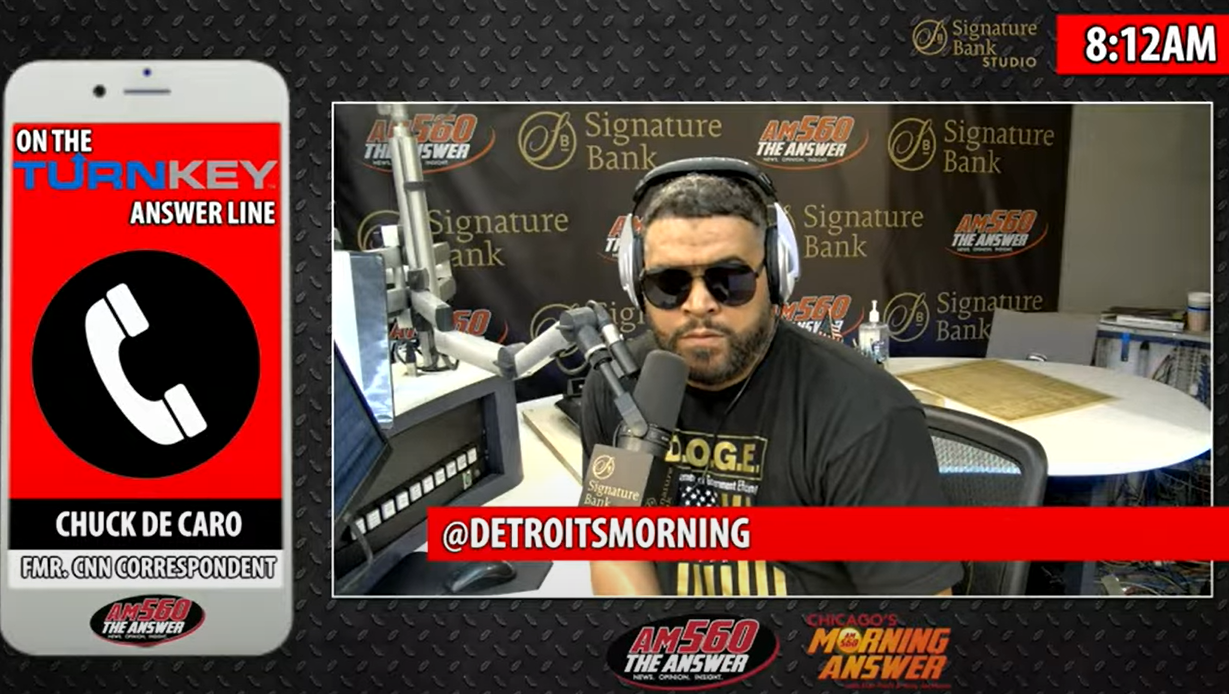
Guest hosting on Chicago’s Morning Answer, John Anthony welcomed former CNN special correspondent and Pentagon consultant Chuck de Caro for a thought-provoking conversation about what de Caro calls America’s “outdated circuitry.” His message was clear: before the government flips the lights back on, it needs to rewire the entire system.
De Caro—who served in the 20th Special Forces Group, advised the Pentagon’s Office of Net Assessment, and helped shape modern information warfare strategies—argued that the federal government’s patchwork design has created inefficiency and confusion. “If we were the founding fathers of the United States today, how would we design the government?” he asked. “We’ve spent 250 years reacting to crises rather than fundamentally designing a system that works.”
A Department of National Economy
De Caro’s proposal begins with consolidating key agencies into what he calls a “Department of National Economy.” Under this structure, departments like Commerce, Labor, Agriculture, Transportation, and Energy would become sub-secretaries working in coordination toward a single goal: increasing national wealth.
“Right now,” de Caro explained, “these departments operate in stovepipes—sometimes against each other, often in ignorance of one another. Imagine the efficiency if they were aligned around a unified mission.” He contrasted the United States’ fragmented structure with China’s long-term economic strategy, warning that America’s short political cycles make it difficult to sustain generational policy.
Reimagining Homeland Security and Intelligence
De Caro didn’t stop with economic reform. He also called for sweeping changes to the nation’s security apparatus, arguing that both the Department of Homeland Security and the U.S. intelligence community suffer from fragmentation and redundancy.
“Eighteen different intelligence agencies aren’t trained the same way. They don’t even speak the same institutional language,” he said. His solution? Fold Homeland Security into the U.S. Coast Guard—an organization he praised for its discipline, efficiency, and adherence to the Uniform Code of Military Justice—and rebuild intelligence under a modern version of the World War II-era Office of Strategic Services (OSS).
“The Coast Guard does everything right the first time with limited resources,” de Caro said. “If every federal agency functioned with that level of accountability, we’d have a far stronger country.”
The Digital Battlefield and America’s Blind Spots
Turning to global threats, de Caro warned that China’s advances in technology, biosystems, and information warfare pose a far greater risk than many in Washington acknowledge. He described America’s vulnerability as structural as much as strategic—rooted in outdated institutions, lagging education, and an inability to adapt quickly to new domains of warfare.
“In information warfare, the problem is that by the time the military recognizes a new threat and sets up a school to train for it, the time to act has already passed,” de Caro explained. He suggested leveraging civilian expertise—particularly from Silicon Valley and the entertainment industry—to maintain an edge in cyber and information operations.
A Call for Modern Cincinnatus Leadership
De Caro closed the conversation with a reflection on leadership and civic virtue, invoking the Roman general Lucius Quinctius Cincinnatus—who led Rome in crisis, then willingly returned to his farm. “We need leaders who serve their country not for power, but for duty,” he said. “That’s what the greatest generation did. They fought, they won, and then they went home.”
A Warning and a Challenge
In his trademark mix of military precision and philosophical depth, de Caro left listeners with a sobering warning: America’s enemies are playing a long game while the United States clings to outdated systems. From bureaucratic sprawl to digital vulnerability, he argued, the nation must modernize its structure—or risk being left behind.
“The circuitry is old,” he said. “If we want to keep the lights on, it’s time to rewire.”