




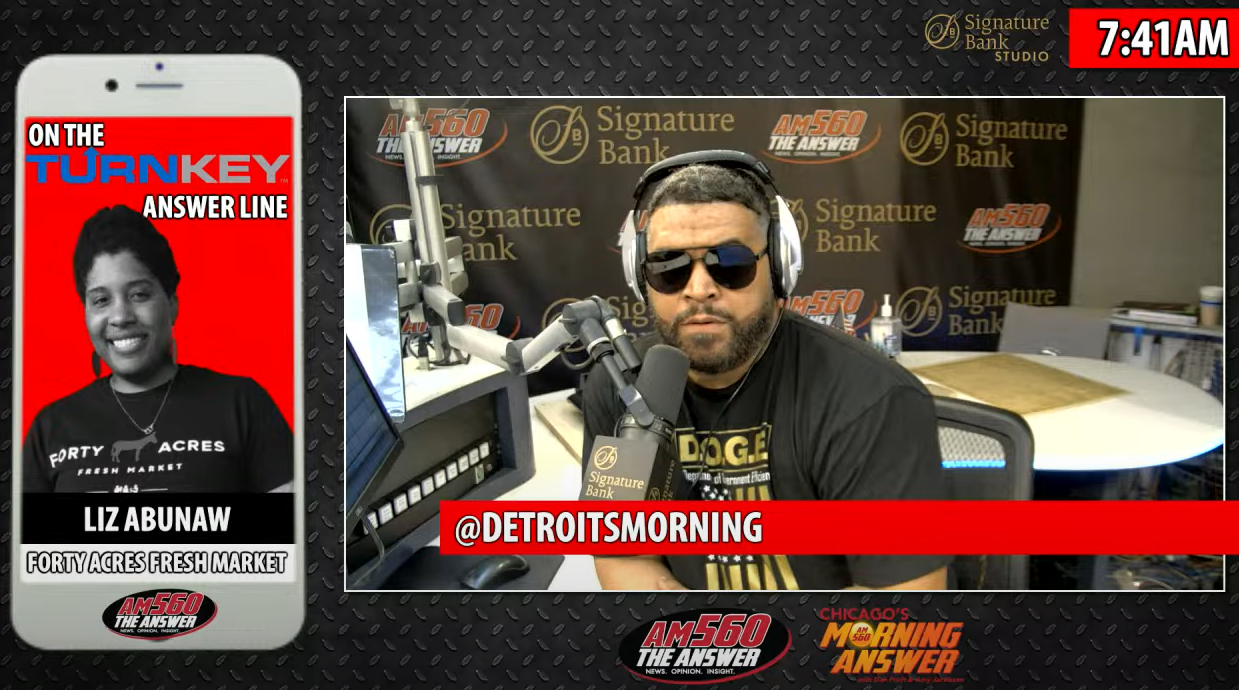
Guest host John Anthony filled in for Dan Proft on Chicago’s Morning Answer with a refreshing conversation that swapped politics for purpose. His guest, Liz Abunaw, owner and operator of 40 Acres Fresh Market, joined the show to talk about how a pop-up produce stand turned into Chicago’s only Black-owned, full-service grocery store—right in the heart of the Austin neighborhood.
Abunaw, a Cornell University graduate with a background in sales and distribution at General Mills, launched 40 Acres Fresh Market in 2018 with a simple idea that’s since grown into a movement: make fresh, healthy food accessible—and do it through business, not charity. “Here’s what I know,” Abunaw said. “People eat. Every day. Multiple times a day. So, why shouldn’t everyone have access to good, fresh food where they live?”
Her journey began with something as ordinary as trying to get cash from an ATM. “I didn’t want to pay a $5 fee to get $20 out,” she recalled. “But that experience opened my eyes to how expensive it is to be poor—and how unequal access really looks in Chicago.” That small frustration sparked a bigger realization: while some neighborhoods are overflowing with grocery options, others—often majority-Black communities—are left with long bus rides, corner stores, and limited options.
From there, Abunaw decided to do something about it. But her approach was not rooted in activism—it was rooted in entrepreneurship. “I’m not there to save a neighborhood,” she told Anthony. “I saw an opportunity. If residents are already spending money on groceries outside their community, why can’t those dollars stay local?”
That mindset is what drives 40 Acres Fresh Market. The new store, now open at 5713 West Chicago Avenue, offers a full line of groceries—fresh produce, a butcher counter, bread, milk, eggs, and even international staples like harissa and tortillas. “We don’t come to play,” Abunaw said with a laugh. “You can walk out your door, walk a few blocks, and get what you need. That’s what makes a neighborhood feel whole.”
Anthony praised the store’s for-profit model—a distinction Abunaw says is crucial. “When you’re for-profit, you have to make money. You have to build something sustainable,” she explained. “There’s this misconception that Black neighborhoods can’t sustain commerce. I reject that. The money is there—it’s just being spent somewhere else.”
When asked about challenges, Abunaw didn’t sugarcoat it. “It’s been extremely difficult,” she said. “Funding was tough, especially early on. We were lucky that programs like the Healthy Food Financing Initiative and the American Heart Association’s Social Impact Fund opened doors for small businesses like ours.” She also credited state programs under Governor J.B. Pritzker that supported minority-owned businesses.
But beyond financing, Abunaw said the hardest part has been managing people. “Human resources isn’t just paperwork—it’s people,” she said. “You’re dealing with real lives, real problems, real emotions. That’s been the steepest learning curve.”
On one topic often raised about urban retailers—shoplifting—Abunaw offered a reality check. “I can count on two hands the number of times we’ve dealt with theft since 2018,” she said. “Theft happens everywhere. It’s retail. But the idea that crime alone explains food deserts? That doesn’t hold up. These neighborhoods have been the same for decades—same demographics, same challenges—and they used to have grocery stores that lasted for years.”
Instead, she pointed to broader structural shifts in the grocery industry. “Policies in the ’80s allowed big-box chains like Walmart to dominate. Smaller, community grocers couldn’t compete on price. That’s what wiped out a lot of neighborhood stores—not just crime.”
For Abunaw, 40 Acres Fresh Market isn’t just about selling produce—it’s about proving a point: that Black communities can build and sustain profitable, community-serving businesses. “It’s commercial,” she said. “It’s local. It’s ours.”
Residents can find 40 Acres Fresh Market at 5713 West Chicago Avenue or online at 40acresfreshmarket.com (that’s “forty,” not the number). The market is active on social media as well, with more than 7,000 followers across Instagram, TikTok, and Facebook.
Anthony closed the segment by thanking Abunaw for her vision—and promising to bring her back on his own Black and Right Radio show. “This is the kind of story we need to tell more of,” he said. “It’s not about charity—it’s about ownership, opportunity, and the kind of Chicago we all want to live in.”