




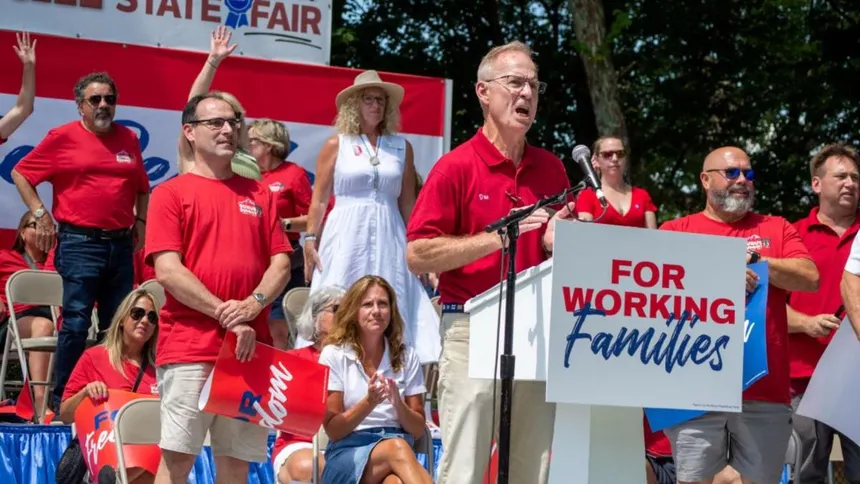
The race to replace retiring U.S. Sen. Dick Durbin is beginning to take shape in Illinois, with Republican nominee Don Tracy and Democratic nominee Lt. Gov. Juliana Stratton presenting sharply contrasting messages on the economy, immigration, and the role of government.
Tracy, a former chairman of the Illinois Republican Party and a Springfield-based attorney and business executive, said his campaign will focus on what he described as a choice between economic opportunity and long-term dependency on government programs.
“This race is about economic freedom versus a culture of dependency,” Tracy said, arguing that Democratic policies at both the state and federal level have expanded welfare programs at the expense of workforce participation and economic growth.
Tracy pointed to recent federal legislation that includes work requirements for certain benefits as an example of policies he supports, saying such measures encourage employment and reduce long-term reliance on government assistance.
Stratton, who was selected as the Democratic nominee with the backing of Gov. J.B. Pritzker, has centered much of her early messaging on opposition to former President Donald Trump, including campaign statements calling for aggressive action on immigration policy and federal law enforcement agencies.
Tracy said that approach reflects a broader strategy by Democrats to nationalize the race rather than focus on state-specific issues.
“They’re running against Washington,” Tracy said. “I’m running for the people of Illinois.”
The Republican nominee also sought to tie Stratton to policies enacted under Pritzker’s administration, including spending on services for migrants and criminal justice reforms that have drawn criticism from GOP leaders.
He argued that Illinois voters are increasingly frustrated with high taxes, public safety concerns, and what he described as a lack of accountability in state government.
“People are going to have to decide whether they want more of the same policies or a different direction,” Tracy said.
Immigration is expected to be a central issue in the campaign, with Tracy criticizing sanctuary policies and Democratic support for expanded benefits for undocumented residents. He said those policies have contributed to increased state spending without addressing broader economic challenges.
At the same time, Tracy acknowledged that winning statewide office as a Republican in Illinois requires rebuilding support in suburban areas, where the party has struggled in recent election cycles.
He said his campaign plans to focus heavily on outreach in Cook County and the surrounding collar counties, emphasizing economic issues and public safety as areas where he believes voters may be open to change.
“You have to compete in the suburbs to win statewide,” Tracy said.
Tracy’s background includes leadership roles in both business and state government, including service as chairman of the Illinois Gaming Board. He said that experience, along with his tenure as state party chairman, has prepared him to campaign across a geographically and politically diverse state.
The broader challenge, he said, is convincing voters to reconsider long-standing political alignments in a state dominated by Democrats.
“Illinois has been a one-party state for too long,” Tracy said. “That’s not healthy for any state.”
The outcome of the race will likely hinge on turnout and whether Republicans can narrow the gap in suburban and urban areas while maintaining strong support in more conservative regions of the state.
With months to go before the general election, both campaigns are expected to intensify their efforts to define the stakes for voters, setting up a contest that reflects not only competing candidates but competing visions for the state’s future.