




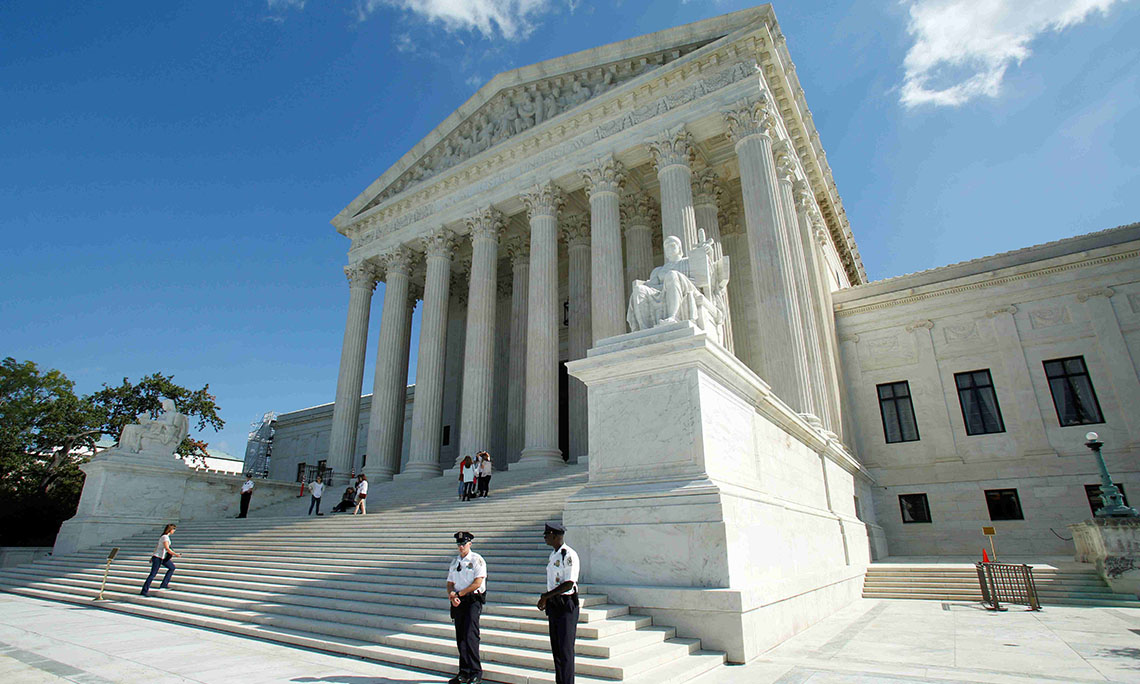
The Supreme Court’s decision holding that Section Two of the 1965 Voting Rights Act does not permit race-based congressional district drawing produced the predictable wave of Jim Crow comparisons from Democratic politicians and cable news commentators, but immigration and national security attorney Alicia Nieves, writing from Chicago, told Dan Proft on Chicago’s Morning Answer that the fury is better understood as a threat to Democratic political architecture than as a threat to the actual civil rights of minority voters.
Nieves said the emotional reaction from groups like the ACLU and the NAACP, which have built a substantial litigation industry around Section Two claims, reflects the loss of a strategic tool rather than any genuine injury to African-American voters’ ability to participate in elections. The decision, she said, closes off an expansion of Section Two jurisprudence that civil rights organizations had been quietly pursuing for years, attempting to convert the provision from a shield against overt racist disenfranchisement into an affirmative sword requiring race-conscious district drawing to ensure minority representation at specified levels. The key insight she offered is that the groups driving this litigation were not primarily focused on African-American population growth, which she said has increased by only about one percent per decade in recent decades. The real demographic targets were Hispanic and South Asian populations, whose explosive growth in certain states represents far more electoral opportunity for Democrats. The legal and rhetorical infrastructure of African-American civil rights history provided the emotional and precedential foundation for advancing claims that were increasingly oriented toward capturing those newer demographic groups as they moved into suburban areas.
She said what the court’s decision actually does, and what makes Democrats genuinely angry rather than performatively angry, is prevent the drawing of the elaborate snake-shaped districts designed to capture minority voters as they disperse into suburban communities from urban cores. The data she cited shows racial segregation steadily declining, with African-Americans, Hispanics, and South Asians increasingly moving into integrated suburban communities, and the rate of that integration is particularly high for Hispanic and South Asian populations. Democrats needed race-based redistricting precisely to prevent those voters from becoming competitive targets for both parties as they moved into communities where their economic and social interests might pull them in different ideological directions. Without the ability to carve them into specially constructed majority-minority districts, they become accessible to Republicans in a way they have not been when the district architecture effectively foreclosed competition.
She raised the question that she argued nobody pushing the civil rights framing wants to answer: how have majority-minority districts actually performed for the majority-minority constituencies they were drawn to represent? Her answer was pointed. In Chicago, in Mississippi, and across the urban political landscape where these districts have been most prevalent for thirty years, the result has been captured constituencies with no competitive outlet for political dissatisfaction other than the occasional presidential race. Poverty, city mismanagement, and chronic underinvestment have been the actual outcomes because when a political party has no competition for a constituency, it has no incentive to deliver results for that constituency. The race-based districting that was sold as protective has functioned as a political trap, concentrating minority voters in districts where their votes are taken for granted and their material interests are neglected.
She said the ruling creates an opening for a different and healthier political dynamic in which both parties have to compete for minority voters on the basis of policy appeals rather than assuming demographic capture through district engineering. For Republicans, she acknowledged this presents a genuine strategic challenge: operatives and donors have long calculated that spending resources on outreach to African-American and Hispanic voters is not worth the investment when those voters are locked into uncompetitive districts regardless of policy arguments. The ruling changes that calculus by creating competitive districts in which minority voters’ preferences are actually in play, which in turn creates incentives for Republicans to develop and present policy platforms with genuine appeal across racial demographics. She noted that for many Hispanic and South Asian voters in particular, conservative values on family, religious faith, and economic opportunity already represent natural common ground that has been suppressed rather than expressed by the current district architecture.
The immediate electoral implications are also significant, with analysts estimating that ongoing state remapping combined with the ruling’s effect could produce somewhere in the range of two dozen additional Republican-competitive seats heading into the midterm elections. Nieves said that near-term Republican enthusiasm about the ruling is justified, but that strategists should understand that more competitive districts cut both ways, and that a natural absorption of minority voters into formerly homogeneous Republican districts will change those districts’ political character over time in ways that require the party to broaden its appeal rather than simply banking on demographic insularity.