




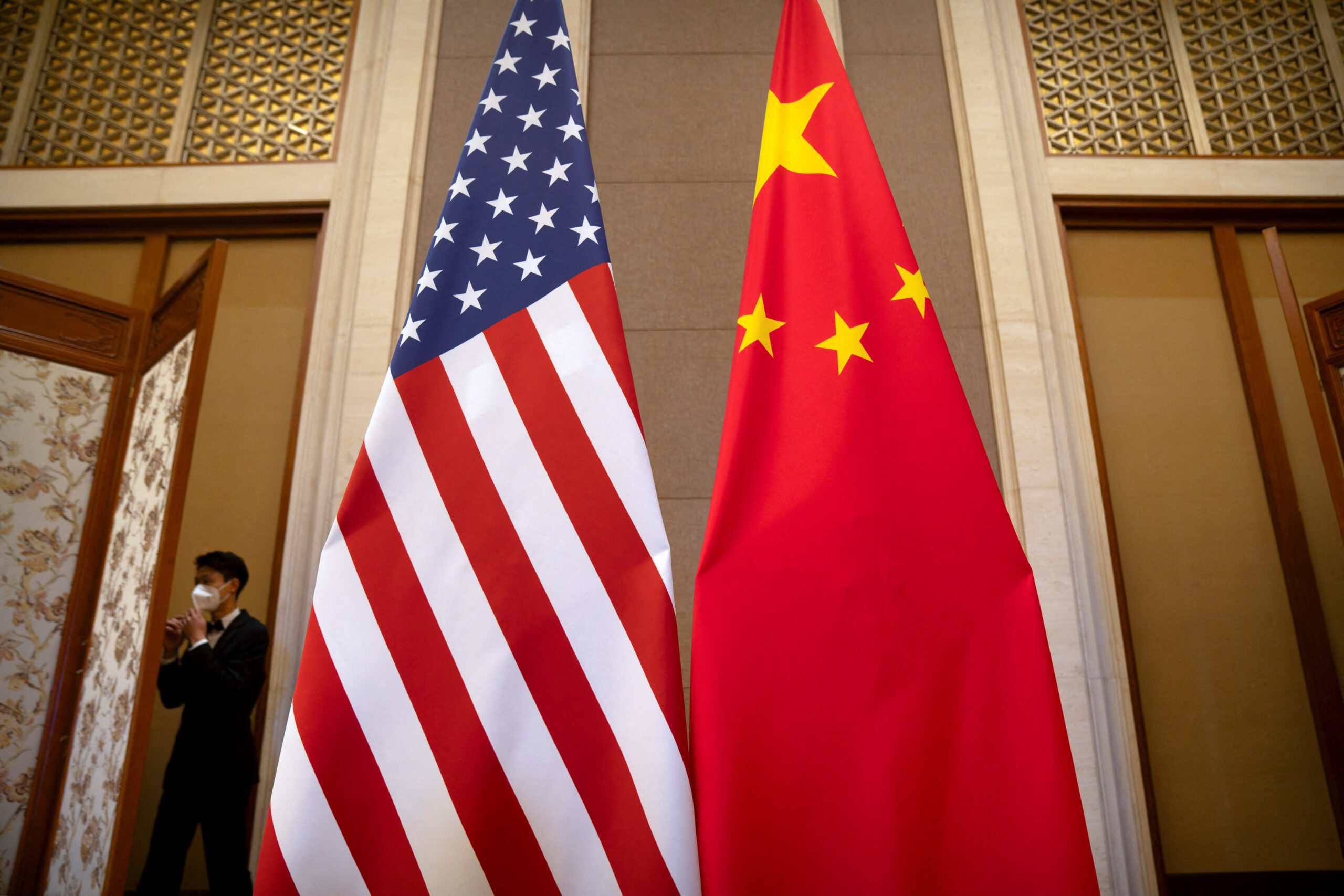
President Trump departed for Beijing with a delegation of major American business leaders including Apple CEO Tim Cook, Nvidia’s Jensen Huang, and Elon Musk, for a summit with Chinese President Xi Jinping that Gordon Chang, author of Plan Red: China’s Project to Destroy America, joined Dan Proft on Chicago’s Morning Answer to assess. Chang pushed back on the narrative from Foreign Affairs and Atlantic commentators suggesting Trump arrives at the meeting from a position of weakness, arguing that the overall balance of power strongly favors the United States even if the optics of traveling to Beijing on China’s home turf create a surface impression of deference.
Chang’s core argument is straightforward: America has a resurgent economy while China’s is failing, Trump has been systematically removing China’s allies and proxies from the board, and Xi Jinping is increasingly isolated internationally despite his domestic political consolidation. He traced the momentum shift to January 3rd, when Trump extracted Nicolas Maduro and his wife from Caracas, effectively taking Venezuela off the board as a meaningful Chinese partner. Since then, Iran has been substantially degraded in both military and industrial capacity, Russia’s position in Ukraine has deteriorated to the point where Putin has publicly acknowledged the war may be ending soon after absorbing over a million casualties and devastating his military’s readiness, and Cuba is under renewed American pressure. China has entered the Beijing summit with fewer meaningful allies and proxies than it had at the start of the year, and those that remain are in no position to provide material support.
He said the one area where China holds a genuine advantage for the summit is the setting itself, and that Xi Jinping is currently displaying a level of arrogance that Chang believes reflects a misreading of the relative strength of the two countries. He said Xi has been strengthened among civilian officials but continues to face erosion of his position within the military, with purges intensifying rather than slowing. He noted the telling pattern that Xi has been removing senior officers he himself put in place, which suggests the internal military situation is more fluid and contested than official Chinese presentations convey.
On Chinese espionage in American institutions, prompted by the case of a California mayor pleading guilty to acting as a Chinese agent, Chang said the problem is primarily American rather than Chinese. The Communist Party’s targeting of people of Chinese descent, whether Chinese nationals or American citizens, has been known for decades across academic institutions, government offices, and major industries. He said the United States has been too squeamish about confronting the ethnic targeting dimension of Chinese espionage operations and needs to be considerably less squeamish in its law enforcement focus.
On Taiwan, Chang said he hopes Trump adheres to the longstanding American policy of not discussing Taiwan’s defense with Beijing, noting that departing from that policy signals weakness and that China consistently exploits any sign of American weakness. On AI, he expressed concern about suggestions from some quarters that the United States should pursue cooperative arrangements with China on artificial intelligence development, and said the American lead in AI is a strategic asset that should not be diluted through technology sharing with an adversarial power.
He said Jimmy Lai, the imprisoned Hong Kong media owner, should be explicitly demanded as part of any discussion with Xi, and noted that Trump has indicated he intends to raise the issue. He said given Lai’s age and the conditions of his imprisonment, urgency matters and a demand rather than a request is the appropriate posture.