




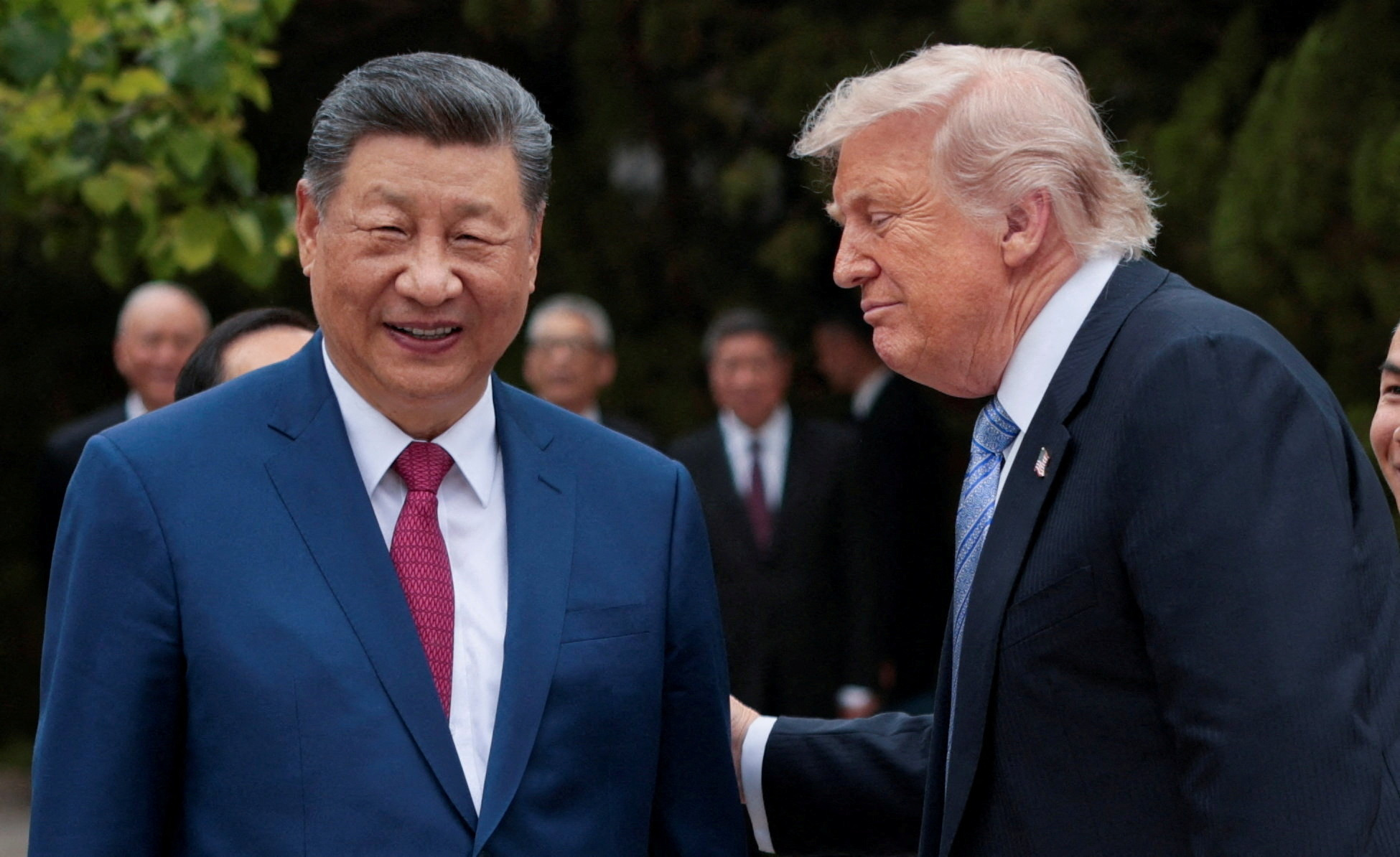
The back-slapping warmth of President Trump’s Beijing summit with Xi Jinping has already given way to the underlying reality of competing interests, with Xi warning that the bilateral relationship will enjoy stability only if Taiwan is handled properly, Taiwan’s president separately stressing that American arms sales represent the most important deterrent of regional conflict, and the Iranian situation unresolved despite Xi’s offer to help however he can.
Geoffrey Cain, author of The Perfect Police State: An Investigation Into China’s Surveillance Dystopia and the new book Steve Jobs in Exile: The Untold Story of Next and the Remaking of an American Visionary, joined Dan Proft on Chicago’s Morning Answer to offer a post-mortem on the summit and its implications.
Cain said the summit was unusual because it was not fundamentally about any specific transaction. The typical US-China summit produces a trade deal, a soybean purchase commitment, or an airplane sales announcement. This one was primarily about the energy of the encounter and what it could be made to signify for Chinese domestic propaganda. Xi Jinping’s goal was to present China as a great civilization standing side by side with the United States as an equal, with the American president and his entire entourage of the world’s most powerful corporate executives traveling all the way to Beijing to meet him. That is the message the Chinese Communist Party wanted to project to its own people and to the world, which is that China is rising and the Americans are acknowledging it by making the pilgrimage. Cain acknowledged that Trump’s decision to bring Musk, Cook, Jensen Huang, and the rest could be read in the opposite direction, as a demonstration of American economic power, but said the Chinese side has clearly framed the summit as a reset in which Beijing showed strength and refused to bend.
He said Asian allies, particularly Japan, did not receive the summit well because of continued ambiguity about Taiwan arms sales, which are currently on pause without a clear indication of whether they will resume. He said the Japanese prime minister recently invoked the legal language that would allow Japan to come to the collective defense of Taiwan if China invades, a significant public commitment that now requires follow-through. The question those allies are asking is whether America will actually show up alongside them if it comes to that, and the summit did not answer that question clearly.
On the reported decision to greenlight Nvidia chip sales to a half-dozen identified Chinese firms, Cain was emphatic that this is a serious mistake. He said China’s government is explicitly pursuing AI supremacy with the stated goal of building a perfect surveillance state that can be extended beyond its borders and exported to other authoritarian governments. Sophisticated AI chips are the most powerful tool in human history for surveillance applications, and the Chinese firms in question are state-linked entities, many of them already under American sanctions, that will deploy whatever capability they acquire directly in service of that surveillance and military expansion agenda. He said handing that capability to a hostile authoritarian nation’s Communist Party, regardless of the diplomatic atmosphere surrounding the decision, is something that should not happen.
He discussed the surveillance infrastructure that Fox News anchor Bret Baier documented during the summit, with cameras on every corner of Beijing, fifteen hundred new cameras added this year alone, and a system sophisticated enough to issue a parking ticket automatically within two minutes of a violation. Cain said there is no ambiguity about the Chinese Communist Party’s intent. Total surveillance of every citizen, monitoring extended to overseas Chinese communities, and the use of AI to make the system increasingly granular and comprehensive is the explicitly stated goal. He said he has encountered Chinese intelligence agents personally in overseas reporting, watching local Chinese diaspora communities, and that the program is active and expanding.
On Xi’s apparent confidence in projecting Chinese strength despite significant economic headwinds, Cain said the confidence is partly a performance driven by domestic political necessity. The Chinese Communist Party’s claim to legitimacy rests on its role as the steward of the economic growth that transformed China over the past two decades. When growth slows, property prices fall, debt levels rise, and structural problems like an aging population from the one-child policy accumulate, the party faces a legitimacy problem it has no democratic mechanism to resolve. Xi’s next party congress is approximately eighteen months away, after which he will almost certainly be reappointed, potentially on a path to becoming president for life in a way that has no modern Chinese precedent. The aggressive posture toward America and the rhetoric of 5,000-year Chinese civilization rising to reclaim its rightful place are Xi’s tools for keeping his people focused on national glory rather than on falling asset values and opaque debt instruments. He said the Chinese economy is substantially worse than outside observers can verify because the country is so opaque and its accounting so unreliable, and that Xi is more worried about internal economic decline than his public presentation suggests.