




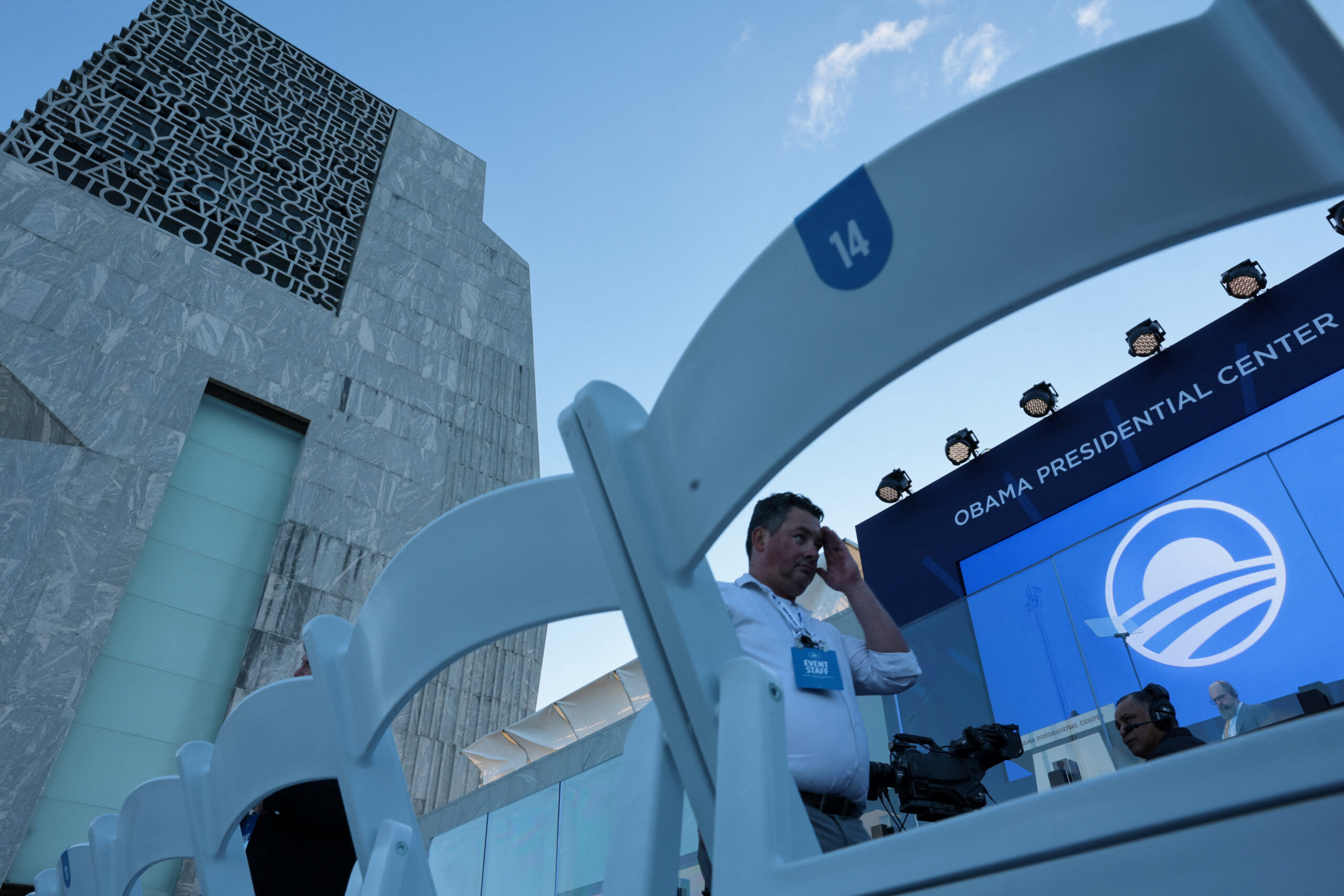
The Obama Presidential Center held its star-studded grand opening this week with performances from Jennifer Hudson, Common, Eddie Vedder, Bono and the Edge, Bruce Springsteen, Marc Anthony, and Christina Aguilera, even as the project’s financial picture continues to deteriorate. Mike Owen, owner of Adamson Plumbing, told reporters he is nearly four million dollars in the red after years of work on the project and described it as a hole no subcontractor, large or small, can survive. The project originally projected to cost around $300 million has ballooned to figures variously reported between $830 million and considerably more, and Fox News has reported that the endowment promoted as a $470 million financial safeguard contains approximately one million dollars. Advocates for Black-owned subcontracting firms say many of those companies have been silenced by non-disclosure agreements and reluctance to jeopardize their standing on a project associated with Obama’s adopted hometown.
Professor Richard Epstein, the James Parker Hall Distinguished Service Professor Emeritus of Law and senior lecturer at the University of Chicago, who led the unsuccessful legal challenge against the project, joined Dan Proft on Chicago’s Morning Answer to assess the financial exposure and explain how the litigation collapsed.
Epstein said the Obama Foundation’s own numbers, even taken at face value, do not hold up to scrutiny. The Foundation’s most recent disclosure, from 2021, claimed it had received $485 million against a project cost of $482 million, a margin of less than one percent, with no audited accounts to verify the figures and no accounting for the inevitable fallout rate on pledged but uncollected donations. Within two months of that 2021 statement, cost estimates had already risen by roughly $200 million, and by the time the project reached completion the figures were reported between $750 million and $850 million, all before factoring in COVID-related disruptions, inflation, and additional overruns. He said the Foundation was contractually required to conduct another financial review before closing the deal and never did.
He said the deeper definitional problem is that the Foundation has redefined what an endowment means. An endowment requires money actually deposited and available. The Foundation’s 2021 statement described a plan to raise $300 million annually for five years, which is a promise to raise future money, not an endowment in any meaningful sense, and that promised fundraising never materialized at anywhere near the scale described, with large grants the Foundation did receive earmarked for other purposes, including, he noted pointedly, Valerie Jarrett’s salary.
On the legal history, Epstein recounted that the public trust doctrine, which he has written about since developing a maxim on the subject in the 1980s, exists specifically to prevent public property from being transferred to private parties without fair compensation to the public. The land transfer in Jackson Park, brokered by then-Mayor Rahm Emanuel, gave the Obama Foundation public parkland for ten dollars, with the city separately absorbing legal costs and infrastructure work. Despite that history, Judge Blakey, an Obama appointee, ruled there was no live public trust claim because the city council had repeatedly voted to approve the project, even though the entire purpose of the doctrine is to constrain exactly that kind of legislative rubber-stamping. On appeal, Judge Amy Coney Barrett ruled against Epstein’s side on the theory that they had pleaded a nuisance case, which Epstein said they had never argued, calling it a case lost on a claim they did not bring. He said a similar pattern occurred before Judge Diane Wood, who recharacterized the claim as a third-party beneficiary case, a legal theory that does not match the facts and that Epstein’s team had likewise never argued.
Epstein’s broader conclusion is that being correct on the legal merits accounts for only a small fraction of actually winning a case against a government-connected entity. He said the courts found procedural off-ramps at every level specifically because the project was always going to be approved regardless of the substantive merits, and that includes Judge Barrett, whom he holds equally responsible for the outcome.
On what the unpaid contractors can do now, Epstein said they need aggressive public interest lawyers who understand public law specifically, since contractors normally protected by mechanic’s liens on private construction projects cannot lien public property in the same way. He estimated the unpaid amount owed to contractors at somewhere between $100 million and $200 million, separate from the broader cost overruns, and said the project was widely regarded by outside construction experts as poorly managed from the outset given rapid personnel turnover, unconventional site requirements including proximity to water requiring extensive reinforcement, and a single-access culdesac location requiring four separate traffic streams to be merged and reversed.
He expressed particular frustration that a prize-winning design by Chicago architect Graham Balcony for an alternative site on private land near Washington Park, with better infrastructure and none of the environmental and access complications of the chosen lakefront site, was never even acknowledged by the Foundation, which he said was committed from the start to a vanity project regardless of practical considerations. He said his honest assessment of the total financial exposure is that the project is likely more than a billion dollars in the hole when all costs are accounted for, and noted with some dark humor that whatever else can be said about the former president, he has at least proven to be an equal-opportunity deadbeat toward contractors regardless of their size or ownership structure.