




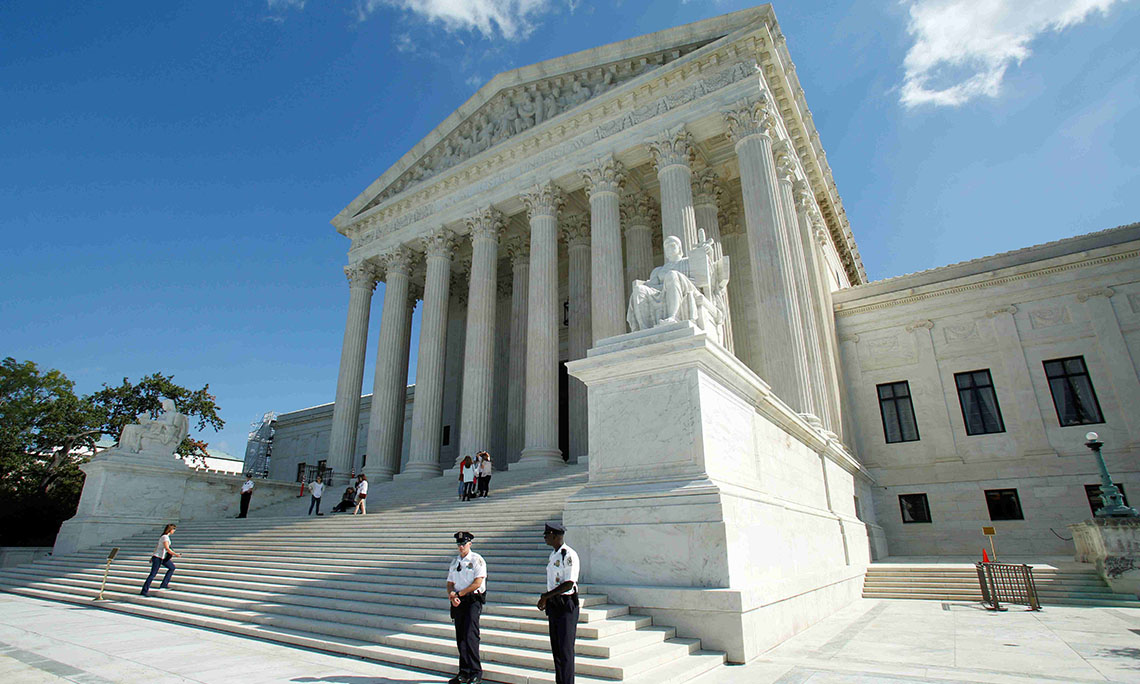
The Supreme Court ruled yesterday in Trump v. Barbara that the Fourteenth Amendment’s citizenship clause grants birthright citizenship to virtually all children born on American soil, with Chief Justice Roberts writing for the majority that what the court held in Wong Kim Ark was simple: the citizenship clause incorporated English common law and conferred citizenship on nearly all children born in the United States, with exceptions limited essentially to children of foreign diplomats who enjoy immunity from American law.
Professor Richard Epstein, the James Parker Hall Distinguished Service Professor Emeritus of Law and senior lecturer at the University of Chicago and author of The Myth of Birthright Citizenship, joined Dan Proft on Chicago’s Morning Answer to deliver what he called an assessment of utter intellectual incompetence.
Epstein said he would not go as far as Federalist editor Molly Hemingway, who compared the decision to Dred Scott and Roe v. Wade, but said it is completely dishonest, an absolute intellectual mess, and the sloppiest opinion on a major constitutional question he has ever read. He directly contradicted Fox News contributor Hugh Hewitt’s assessment that Roberts hit it out of the park, saying Hewitt does not know what he is talking about.
His critique began with the majority’s framing. Roberts opened by stating the court was affirming the right to freely participate in the political community to every person born in this land. Epstein said the opinion was convincing on exactly one point: the Fourteenth Amendment was designed to ensure that the children of formerly enslaved people and their parents were citizens. But he said it had nothing to do with foreign nationals coming into the United States. He noted that the amendment only passed because it explicitly did not confer voting rights on Black Americans or women, and that an 1874 case called Minor v. Happersett, which Roberts did not cite, defined citizenship as a promise of loyalty in exchange for sovereign protection, with voting as a separate and distinct question.
On Roberts’s claim that the citizenship clause incorporated English common law, Epstein said this is flatly wrong. He said naturalization in England was exclusively a parliamentary matter, meaning it was statutory, not common law, and that while the English statute did provide for a version of birthright citizenship, the American statutory framework was fundamentally different. The Naturalization Acts of 1790 and 1795, reflecting Alexander Hamilton’s interpretation of the uniform naturalization clause, began with the words any free white person may apply, which is hardly a statement of universal automatic citizenship. That racial limitation remained in the statute until 1870, four years after Congress passed the Fourteenth Amendment. The defenders of birthright citizenship are claiming automatic citizenship exists as a constitutional right when the most the relevant statutes ever provided was the right to apply, subject to rigorous conditions.
On the word jurisdiction, which is the crux of the Fourteenth Amendment’s qualifying phrase subject to the jurisdiction thereof, Epstein said calling its meaning simple is something only a simpleton would do. He cited Blackstone directly, who distinguished between two forms of allegiance. Local allegiance, which Epstein equated with what we call jurisdiction, means that anyone physically present in a country must obey its laws and can be punished for violations, but this form of allegiance terminates the moment you leave and does not confer citizenship on your children. Natural or full allegiance is the complete loyalty a citizen owes to the sovereign, and that is the form of allegiance that produces citizenship either by birth or by satisfaction of statutory requirements. Roberts conflated the two, which Epstein said renders the entire analytical framework of the opinion incoherent.
He said Roberts’s treatment of the historical context was equally deficient. The Chief Justice claimed that nobody cared about Chinese immigration in the late nineteenth century, a statement Epstein called making a fool of himself given that Chinese immigration was the number one political issue in the country during that period, generating elaborate treaties and ultimately the Chinese Exclusion Acts. Roberts also asserted that the constitutional framework never changed, which Epstein said is obviously false, since immigration was exclusively a state matter at the founding and was very aggressively policed by individual states until the Chinese Exclusion Cases of 1885 federalized the issue entirely.
On the scale of the practical problem, Epstein cited 2023 data showing approximately 300,000 birthright citizenships out of roughly three million total births in the United States, meaning roughly ten percent of all births involve birthright citizenship claims. He said the decision will not withstand the test of time regardless of the praise it is currently receiving from some quarters.
On legislative and executive responses, Epstein said several approaches are constitutionally viable precisely because they operate at the point of entry rather than after birth on American soil. He said proposals to prohibit entry of pregnant women or to require women of childbearing age to sign declarations and post bonds ensuring they will leave if a child is born would likely survive constitutional challenge because every case on the subject, including those written by Justice Horace Gray, holds that the United States has absolute power to exclude anyone from the country with no questions asked. The constitutional debate about due process begins only after someone has been admitted to the country. Restricting entry is a different legal question entirely from revoking citizenship after birth, and it does not run afoul of the Roberts majority because the restriction operates before the predicate fact of birth on American soil occurs. He said he expects these proposals to be litigated and potentially to reach the Supreme Court, where the intellectual inadequacy of the Roberts opinion will be exposed further.