




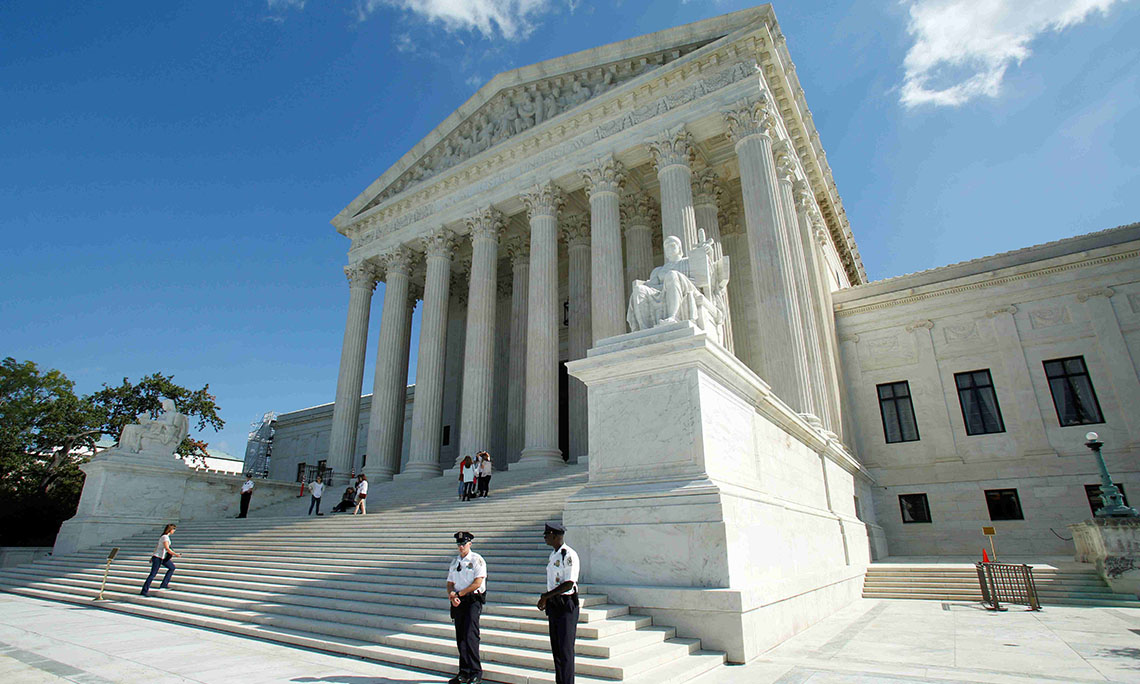
Border security chief Tom Homan reported over the weekend that sixty percent of the approximately eight hundred thousand identified criminal threats have been removed from the country and that nearly half of the three hundred thousand unaccompanied minors who went missing under the Biden administration have been located by DHS. As the Supreme Court prepares to issue its remaining opinions before the term ends, including the birthright citizenship case, a parallel legal battle over mandatory detention of illegal immigrants is working its way toward the high court with potentially enormous policy implications.
Ilan Wurman, the Julius E. Davis Professor of Law at the University of Minnesota and co-host of the Rationally Based podcast, joined Dan Proft on Chicago’s Morning Answer to break down both issues.
Wurman said the mandatory detention question turns on the interpretation of the Illegal Immigration Reform and Immigrant Responsibility Act of 1996, signed by President Clinton and sold at the time as a bipartisan crackdown on illegal immigration. Before that law, aliens who successfully sneaked past the border and entered the country were subject to deportation proceedings that afforded them essentially the same procedural benefits as anyone lawfully present. The entire purpose of the 1996 legislation was to collapse the distinction between exclusion and deportation by creating universal removal proceedings. The statute accomplished this by defining anyone arriving in the United States or physically present without having been admitted as an applicant for admission, and then providing that an applicant for admission who is seeking admission shall be detained pending determination of their immigration status.
The legal debate centers on whether all applicants for admission are necessarily seeking admission, or whether the seeking admission language carves out a special subset that excludes people who entered illegally and have been living in the country for years. Wurman said the Trump administration’s argument is stronger because the entire statutory structure was designed to treat illegal entrants as applicants for admission even though they are not literally applying, meaning an applicant for something is by definition seeking something within the logic of the statute. The opposing side’s best argument, he acknowledged, is that Congress did not provide detention facilities sufficient to house millions of people simultaneously and in fact provided the secretary with waiver authority for capacity constraints under a different section of the statute, suggesting Congress did not contemplate detaining every illegal immigrant in the country. Wurman said that argument has some force but ultimately does not overcome the statutory text, particularly since the government is not arresting two million people on the same day but processing them through the system over time, and capacity can be surged as needed, as demonstrated by the rapid sheltering of millions of migrants under the Biden administration and the recent opening and closing of facilities like the Florida detention site Homan and DeSantis showcased.
He drew a connection to the Supreme Court’s metering decision from last week, in which the liberal justices argued in dissent that the Obama-era policy of stopping asylum seekers on the Mexican side of the border before they arrived perversely incentivized illegal border crossing because sneaking in would trigger the right to have asylum claims processed. Wurman noted with some amusement that the liberal justices’ own logic in that case cuts against their position in the mandatory detention dispute, since opposing mandatory detention for those who entered illegally also incentivizes illegal entry by providing better treatment to those who break in than to those who present themselves lawfully.
On birthright citizenship, Wurman said he is one of the only serious academics to have filed a brief supporting the Trump administration’s position, a distinction that does not enhance his popularity at a liberal institution in Minnesota but that he stands behind on scholarly grounds. He said the conventional wisdom holds that the Fourteenth Amendment’s phrase subject to the jurisdiction thereof refers merely to criminal jurisdiction, meaning anyone who can be prosecuted for crimes on American soil is subject to the jurisdiction and therefore their children born here are citizens. Wurman said he has demonstrated through extensive historical research that this reading is wrong. Indian tribes were subject to federal criminal jurisdiction through the General Crimes Act of 1817 and the Major Crimes Act of 1885, yet nobody at the time of the Fourteenth Amendment’s ratification believed tribal members were included in the citizenship clause. The framers of the amendment told us what they meant by the phrase: complete jurisdiction, legislative, executive, and judicial, the same jurisdiction the country exercises over its own citizens.
Wurman said the Wong Kim Ark case was arguably correctly decided under this framework because lawful permanent residents who are domiciled in the United States are subject to that complete jurisdiction. But temporary visitors and illegal entrants may not be. He cited Union military authorities in Louisiana who during the Civil War era concluded that temporary visitors and children born to temporary visitors could not be conscripted into the military, an indication that they were not considered subject to the full jurisdiction the amendment contemplates.
On whether the Supreme Court will actually rule this way, Wurman said he is not optimistic. He said every current justice grew up during a period when the conventional wisdom on birthright citizenship was treated as settled and obvious, and forty years of that formative experience is difficult to override even with strong countervailing scholarship. He said the court may take what he called a statutory off-ramp, ruling that Congress in the 1940s and 1950s used similar language in immigration statutes in ways that reflected the broad conventional interpretation, and declining to reach the constitutional question. That would technically be a loss for the Trump administration on the immediate question but would leave the constitutional issue open for Congress to address legislatively, though doing so would likely require eliminating the filibuster. He said regardless of the outcome, the scholarship he and others have contributed will be available for the next forty years to challenge the conventional wisdom that has gone essentially unquestioned for the previous forty.