




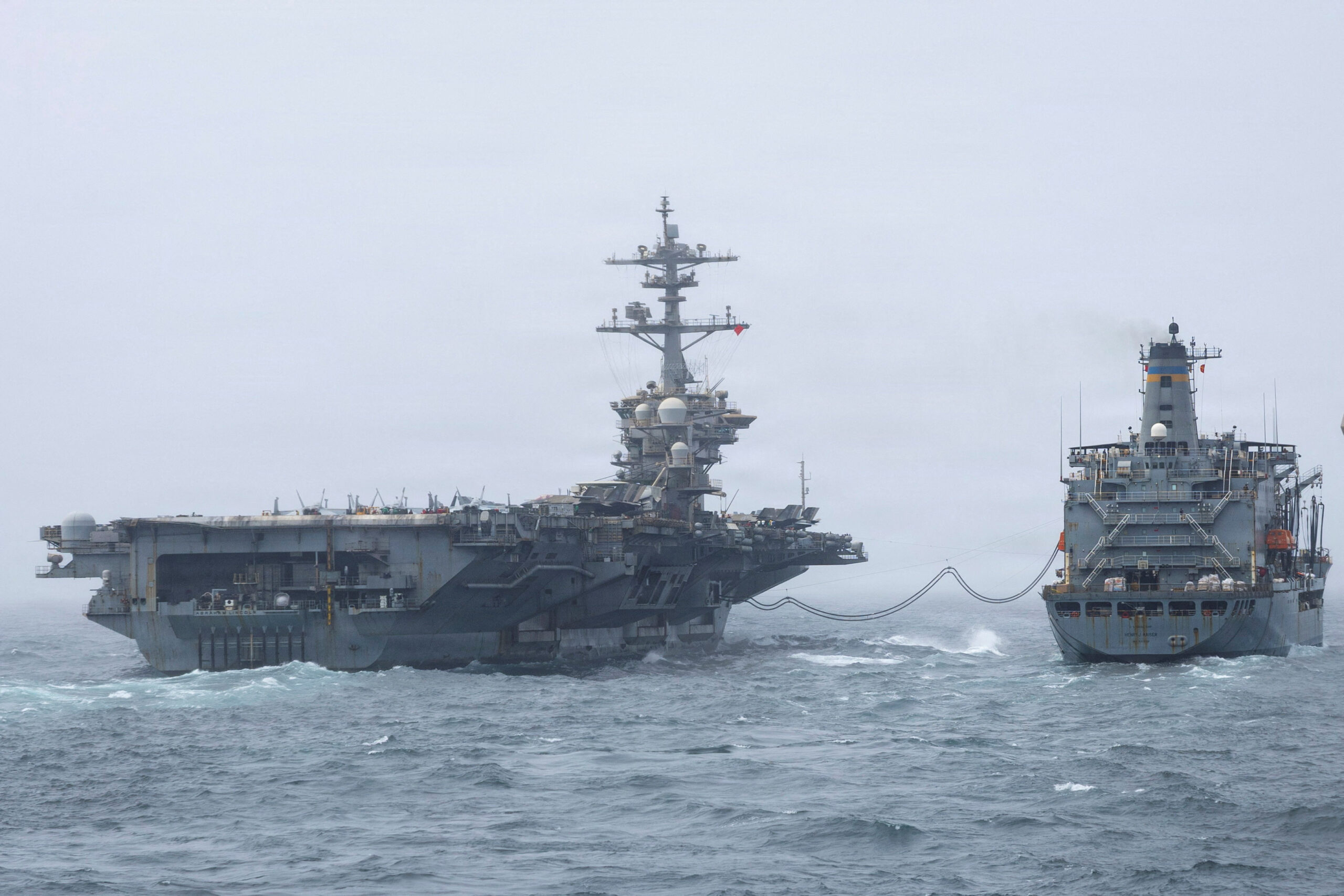
Filling in for Dan Proft on Chicago’s Morning Answer, Jeanne Ives and Jim Iuorio discussed the USS Abraham Lincoln, whose roughly 5,000-member crew has spent much of the past nine months deployed in support of U.S. military operations in the Middle East. The hosts noted recent reporting from Military Times detailing the carrier’s extended deployment, which began in November and was originally expected to end in May, as well as separate incidents in which sailors attempted to go overboard. In one case, according to the wife of a sailor aboard the ship, her husband and several crewmates intervened to pull a shipmate back onto the deck before the situation became fatal.
Ives and Iuorio also referenced a Wall Street Journal piece by Admiral Brad Cooper, commander of U.S. Central Command, who wrote that he addressed the Lincoln’s crew directly aboard the ship in the Arabian Sea to announce that the carrier would finally be returning home after what he called a performance “for the ages.” Cooper wrote that while recent media coverage highlighted concerns about operational tempo and crew morale, much of what he found aboard the ship reflected issues that were already old news by the time he arrived.
To help make sense of the situation, the hosts brought on Captain Guy Higgins, a retired U.S. Navy officer and Naval Academy graduate who logged more than 4,300 flight hours across five deployments during his 30-year career, later working as a vice president at Boeing and as a principal with the consultancy Firestorm. Higgins said the Lincoln’s deployment, approaching nine months with extended periods of intense operations, is genuinely arduous by any standard, but he cautioned against treating the crew’s performance as anything other than exceptional given the circumstances. He said that putting 5,000 people, more than the population of the town where he attended high school, into a high-pressure environment for that long will inevitably produce stress-related incidents, without diminishing the intensity or professionalism of the operation itself.
Drawing on naval history, Higgins referenced a World War II account of a submarine crew that began showing physical symptoms of stress after roughly 40 days of continuous combat operations, noting that human endurance has real limits regardless of era. He said the Navy’s overtasking of ships and personnel isn’t new, recalling his own experience flying three deployments in 30 months earlier in his career, but argued that the Lincoln’s case stems from a more structural problem: the military being sized to fit available budgets rather than actual strategic need.
Higgins traced that dynamic back decades, citing defense analyst Andrew Krepinevich’s observation that the U.S. hasn’t had a true national security strategy, one that identifies specific barriers to its goals and resources their solutions, since the Eisenhower administration. He walked through how the federal budget process divides funding across the military branches in ways that force services to plan for more missions than their budgets can support, leading to fewer ships overall. He noted that the Navy’s fleet has shrunk from roughly 700 ships in the early 1970s to under 300 today, even as its operational demands have expanded, and that stretching deployments, as happened with the Lincoln, has become one of the primary ways the Navy compensates for that gap.
Asked whether the situation aboard the Lincoln reflects a one-off problem or a broader pattern, Higgins pointed to the 2017 collisions involving the USS John S. McCain and USS Fitzgerald in the Western Pacific as another example of the same underlying strain: overtasked ships, fatigued crews and equipment breaking down under sustained use. He said the Navy generally fixes such problems well, but that sustained deployments lasting six months, twelve months or longer eat into the reserve capacity the fleet needs for future contingencies.
Higgins currently serves on the board of advisers for STARRS, Stand Together Against Racism and Radicalism in the Services, and was thanked by the hosts for his insight into both the immediate situation aboard the Lincoln and the broader structural issues facing Navy readiness.