




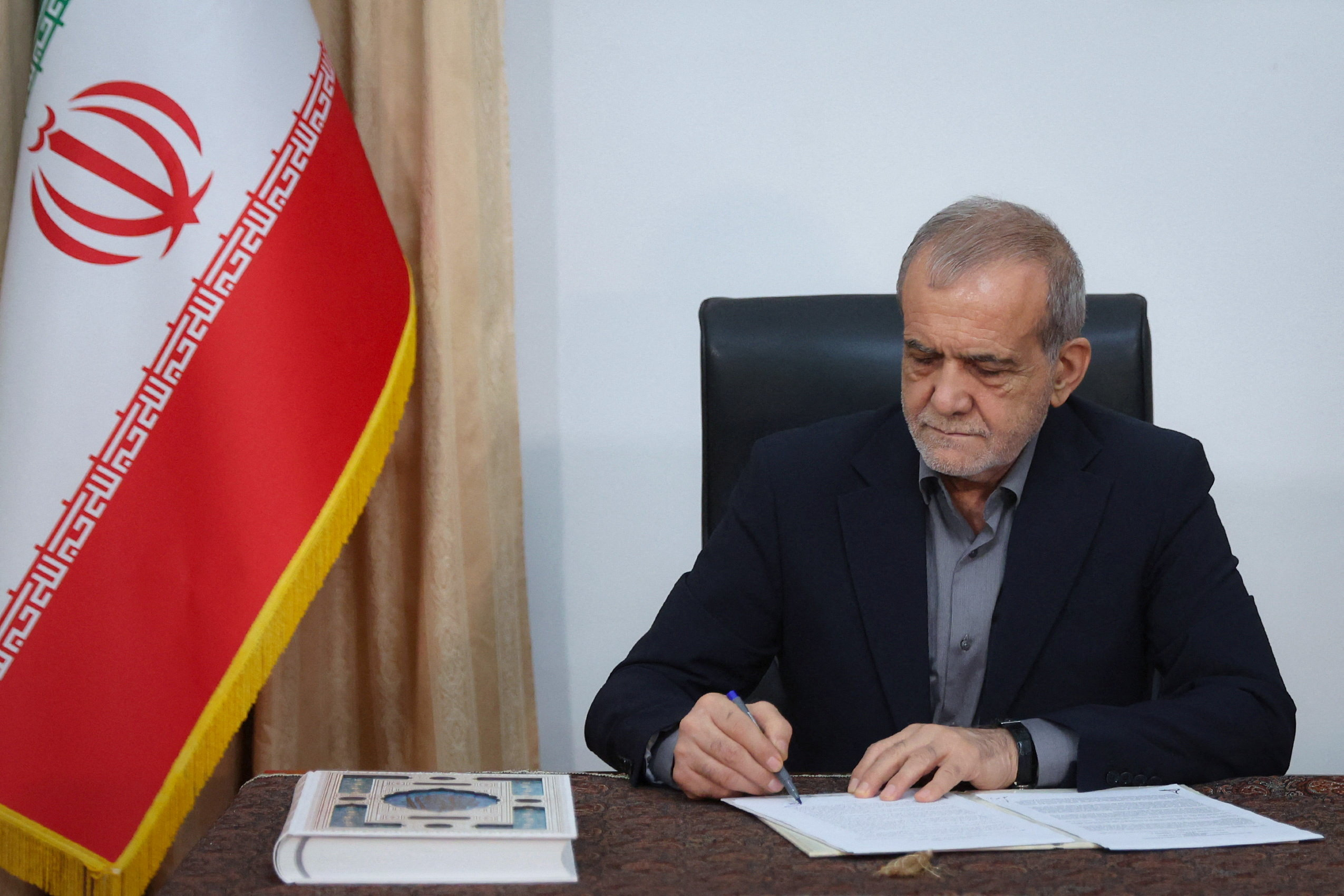
President Trump defended the memorandum of understanding signed with Iran in Versailles during G7 remarks, telling critics who supported the original strikes but have concerns about the settlement that continued bombing would have kept oil shipments from flowing at a cost of five to seven hundred million dollars a day, and that the world’s oil reserves were down to roughly four weeks before the deal was reached. He challenged skeptics to explain why, if they are so smart, they did not support taking out Qasem Soleimani, seemingly unaware that many of the same people backing his current critique also supported that strike.
Eugene Kontorovich, professor at George Mason University’s Scalia Law School and senior fellow at the Heritage Foundation, joined Dan Proft on Chicago’s Morning Answer to assess the deal’s substance.
Kontorovich said the agreement is very disturbing and several of its components are genuinely bad, with the primary mitigating factor being that it covers only sixty days and nothing is permanently resolved. But he said the net effect, considered honestly, is that it strengthens Iran. He noted that on the same day the deal was being celebrated, Iran’s leadership was publicly discussing avenging the deaths of Iranian officials killed by the United States and stating plainly that they intend to direct incoming funds first to Hezbollah, the proxy force that dominates Lebanon including its large Christian minority. He said this directly contradicts the administration’s framing, particularly from Vance, that the Iranian leadership has undergone some kind of fundamental change of heart and now wants what everyone wants, which is simply to make money. Kontorovich said the Iranians do want to make money, but specifically so they can fund the export of violent jihad and dominate the Middle East, and that conflating those two motivations is a serious analytical error inside the White House.
He said the fundamental problem with the structure of the deal is the math. Trump is rightly proud of having smashed the Iranian military and sunk its navy during the campaign. The settlement provides Iran with roughly $300 billion, which will be used to rebuild exactly the military capability that was just destroyed, along with ballistic missile programs and continued support for regional proxy armies. He said the sixty-day window requires almost nothing of Iran in the near term. The reopening of the strait, framed as an immediate concession, is actually only required during the final thirty days of the window, and nothing in the agreement requires Iran to give up its nuclear weapons ambitions at all. He said Iran has every incentive to behave during this window, collect the money, and use the time to rebuild military and missile capacity rather than to genuinely abandon its strategic objectives.
On oil specifically, Kontorovich said the broader strategic problem is that by accepting that Iran can control the Strait of Hormuz and that the United States cannot tolerate oil above one hundred dollars a barrel even briefly, the deal effectively concedes that Iran gets to set global oil pricing going forward. He acknowledged that Gulf states including Qatar and Saudi Arabia have been exploring alternative transport routes that bypass the strait entirely, but said those efforts take a long time to build out and will never be fully effective since land transport is inherently more expensive than shipping, meaning Iran retains meaningful leverage over the global economy for years, which is precisely the window during which Iran will be working to rebuild its nuclear program.
On Trump’s comments about Iranian ballistic missiles, in which the president argued that denying Iran missile capability while allowing Saudi Arabia to have missiles makes no logical sense, Kontorovich pushed back directly. He said it does work that way, because Saudi Arabia has never launched its missiles at neighboring countries even during periods of regional conflict, including when Kuwait was invaded by Saddam Hussein. Iran, by contrast, has demonstrated specifically during this conflict that it will fire missiles at Kuwait, Qatar, Bahrain, Saudi Arabia, and Israel, behaving as what Kontorovich called a sociopathic actor on the regional stage. He noted that Iranian intermediate-range missiles were shown during the conflict to be capable of reaching Western European capitals, which should give German officials reason for concern about the framework Trump is establishing.
He closed by identifying what he sees as the most dangerous long-term lesson available to other actors watching this outcome. Iran holds structural advantages that democracies do not: no domestic political opposition, having eliminated it through brutal repression, no elections forcing short-term political calculation, and a rigid theological commitment that allows for strategic patience measured in decades rather than news cycles. He said the worst possible lesson for the twenty-first century would be that medium-sized, second-rate theocratic dictatorships can out-negotiate the world’s leading democracies and industrial powers simply by virtue of being less free and more willing to behave unpredictably.