




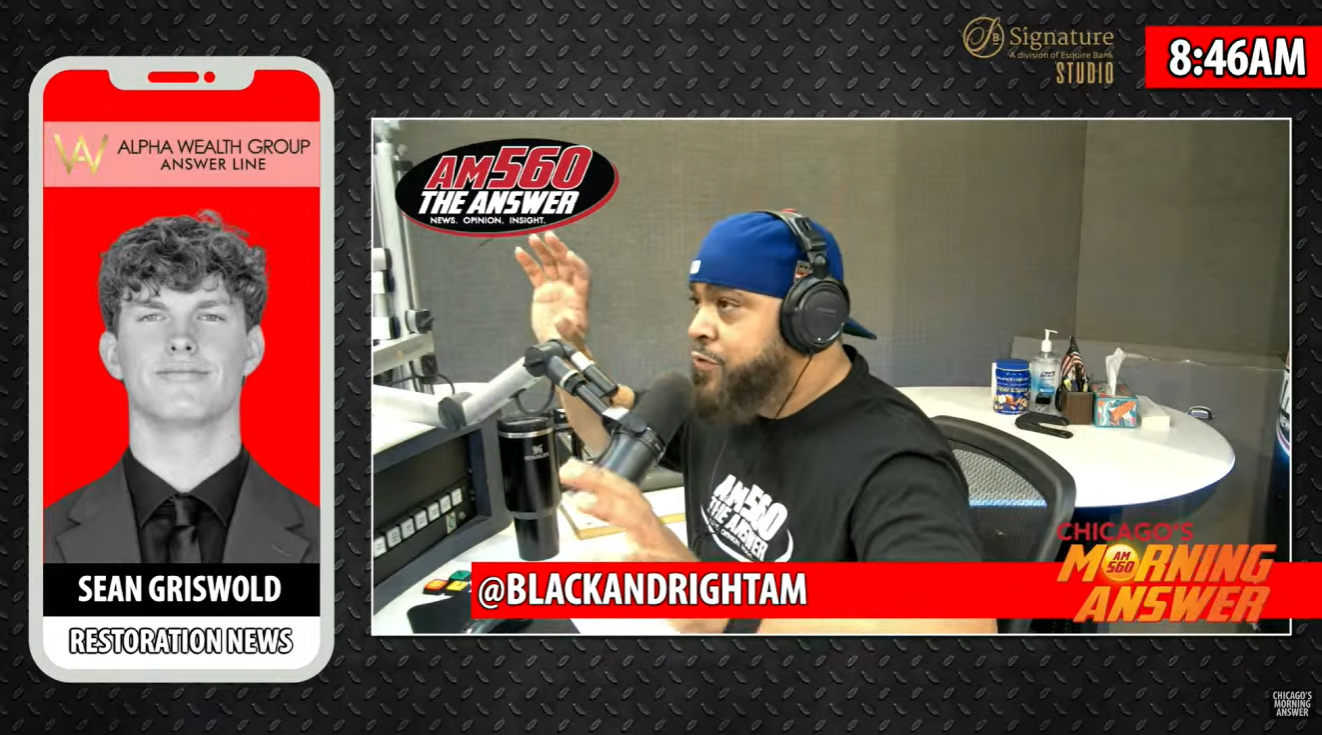
Young voters across the political spectrum are increasingly drawn to candidates who promise to disrupt the political establishment, according to conservative activist and writer Sean Griswold, who argues that economic frustration and a lack of civic education are helping drive the trend.
Griswold joined Chicago’s Morning Answer with John Anthony, who was filling in for Dan Proft, to discuss an article he recently wrote for The American Spectator examining why young voters are gravitating toward seemingly opposing political movements, from Democratic Socialists of America candidates to populist conservatives such as Florida gubernatorial candidate James Fishback.
Griswold, a university student and conservative activist who previously led a Turning Point USA chapter and Young Republicans organization in high school, said one of the biggest mistakes political observers make when analyzing Generation Z is assuming young people have the same understanding of government and civic institutions as previous generations.
According to Griswold, many young Americans have not received the same level of civic education as earlier generations and therefore may not understand why political change can be slow. They see problems that aren’t being solved and often respond to politicians who promise immediate and sweeping solutions.
That dynamic, he said, creates an opening for candidates on both the political left and right who present themselves as outsiders willing to tear down a system that young voters no longer trust.
Anthony noted that young Americans are facing significant economic pressures, including the costs of housing, education and starting families. Griswold agreed that affordability is a central issue connecting otherwise very different political movements.
The difference, he argued, is in the proposed solutions. Democratic Socialists may promise expanded government programs and a dramatically larger role for government, while populist conservatives may emphasize free markets and economic freedom while taking more aggressive positions on specific issues involving technology, regulation and other areas.
Griswold described the phenomenon as a version of the “horseshoe theory,” suggesting that political movements at opposite ideological extremes can sometimes converge around a shared dissatisfaction with the existing system.
Social media is further accelerating that dynamic. Griswold said many young voters are getting their political information from TikTok, X, YouTube, podcasts and short video clips rather than traditional news outlets or political organizations.
The format can create problems, he said, because an hour-long discussion can be reduced to a 15- or 60-second clip that strips away context. Griswold argued that Republicans in particular need to become more effective at communicating in the digital spaces where younger voters actually spend their time rather than continuing to rely on traditional campaign messaging.
Anthony said he has noticed what he considers a repetitive Republican advertising strategy that often appears disconnected from the way younger voters consume information. Griswold agreed that the party needs to adapt if it wants to maintain the support it has gained among younger voters and independents.
The discussion also turned to President Donald Trump and the challenge facing Republicans once Trump is no longer on the ballot. Griswold said Trump has succeeded in building a coalition that extends beyond traditional Republican voters, including stronger support among some Black voters, independents and other groups that have not historically been reliable Republican constituencies.
The challenge for the GOP, he said, will be maintaining that coalition while developing a clearer identity of its own. Griswold suggested that potential future Republican presidential contenders, including Vice President JD Vance or Senator Marco Rubio, would have to retain the voters Trump brought into the party while finding ways to expand the coalition further.
Griswold also emphasized that Republicans cannot take their voters for granted once an election is over. He argued that elected officials need to continue addressing the problems that motivated voters to support them in the first place.
The conversation became more heated when Anthony brought up the reaction among some political activists to the assassination of conservative activist Charlie Kirk. Griswold said the controversy illustrates the intensity of political divisions among younger Americans, while also cautioning that the most vocal activists represent only one part of Generation Z.
He pointed out that a large portion of young voters identify as independents and may move between political parties depending on the candidates, issues and messages that resonate with them. Social media can amplify the most extreme voices, but Griswold said many younger Americans remain politically disengaged or are still deciding where they fit.
That uncertainty, he argued, presents both a challenge and an opportunity for Republicans. If the party can demonstrate that it understands the economic and cultural frustrations facing young Americans, it may be able to maintain some of the gains made during the Trump era.
But simply relying on Trump’s personal appeal will not be enough. Griswold said Republicans will need to develop a political identity that can stand on its own, communicate effectively through modern media and deliver tangible results for the voters who put them in office.
For Griswold, the common thread connecting young voters on both sides of the political spectrum is less about traditional left-versus-right ideology and more about a widespread belief that the existing political system is failing to deliver.
The political movement that ultimately captures those voters may depend on which candidates can convince them that meaningful change is possible—and that they understand the problems young Americans are facing.