




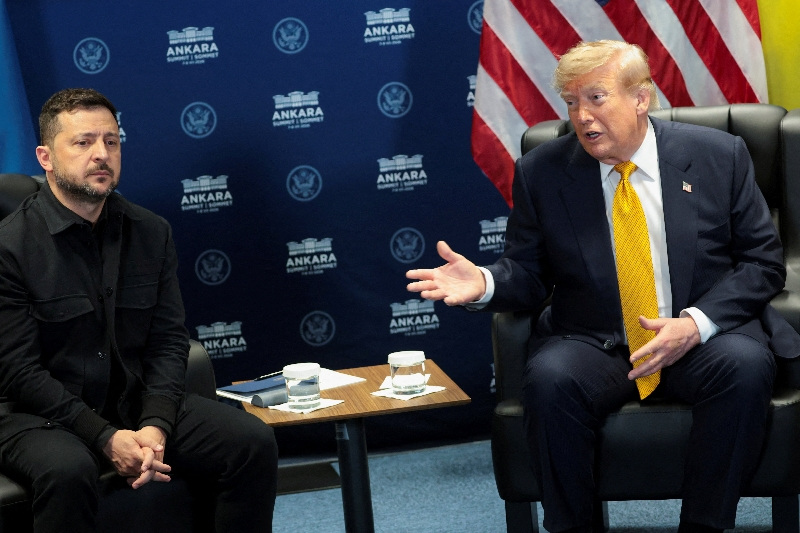
Fresh strain has emerged between the Trump administration and Ukrainian President Volodymyr Zelensky, as President Trump, speaking from Ireland, said he has told Zelensky to halt Ukrainian strikes on Russian diesel refineries. Trump argued the attacks are driving up global diesel prices and singled out that pressure point as the one target he wants off the table, even as he said Zelensky should continue pursuing other objectives in the war.
The comments came as Jared Kushner and Steve Witkoff were dispatched to Eastern Europe to serve as mediators between Moscow and Kyiv. In remarks that Chicago’s Morning Answer host Dan Proft characterized as an implicit complaint about Zelensky’s posture, Kushner described the difficulty of the mediation effort, noting that Russian President Vladimir Putin has laid out the line to which he wants Ukraine to withdraw, and that Ukraine is not currently willing to accept it. Kushner said the American team’s task is to find a creative path that does not violate Ukraine’s objectives while still persuading Russia to end the conflict.
To unpack the moment, Proft turned to Steven Bucci, a retired Army Special Forces officer, former top Pentagon official, and visiting fellow at the Heritage Foundation’s Allison Center for Foreign Policy Studies.
Bucci said he was disappointed by both the diesel-refinery request and by what he heard from Kushner, arguing that while the administration is right not to go all-in on Ukraine’s side, tilting too far toward Moscow is its own form of folly. He rejected the notion that Ukraine bears responsibility for the war, calling Russian justifications for the invasion baseless, and likened the administration’s apparent willingness to ask Ukraine to make concessions to pre-World War II appeasement. He said that while it is reasonable for the White House to want to protect Americans from higher fuel prices, it was a mistake to say so publicly, since doing so signals daylight between Washington and Kyiv that Putin will look to exploit.
Bucci said Putin cannot be trusted to negotiate in good faith, describing him as consistent only in his willingness to say one thing and do another. He pointed to the electoral rise of Germany’s AfD party, whose leader Alice Weidel has pledged to end German support for Ukraine if the party gains power, as a sign that Western resolve could be cracking more broadly. Bucci warned that if European nations allow Russia to absorb Ukraine, the Baltic states and the rest of NATO’s eastern flank would have good reason to worry, since Putin would likely regroup, rebuild his economic and diplomatic leverage, and eventually move again.
Asked to assess the state of the battlefield, Bucci said the war is not in a stalemate so much as a shifting balance, with Ukraine having stopped Russian advances in some areas and increasingly able to strike back using long-range drones it is now producing domestically, weapons effective enough that the United States has begun purchasing them. He said Russia is feeling more pressure than at any point in the conflict, which is precisely why he finds the administration’s apparent openness to a negotiated partition frustrating, since it hands Putin an opening he does not currently have the leverage to demand. Bucci said that while Ukraine could not sustain the fight indefinitely without Western support, it would not collapse immediately if aid were cut off, though the psychological blow could embolden Russia to fight harder rather than negotiate.
On Iran, Bucci said the administration’s strategy of leading with economic pressure, backed by military force, is working, even if it is not resolving the standoff as quickly as many expected. He acknowledged the approach carries political risk for Republicans heading into the midterms, since it depends on Iran capitulating under the strain of sanctions and the ongoing blockade rather than through a swift military resolution, but said abandoning the pressure campaign now would only prolong the conflict.