




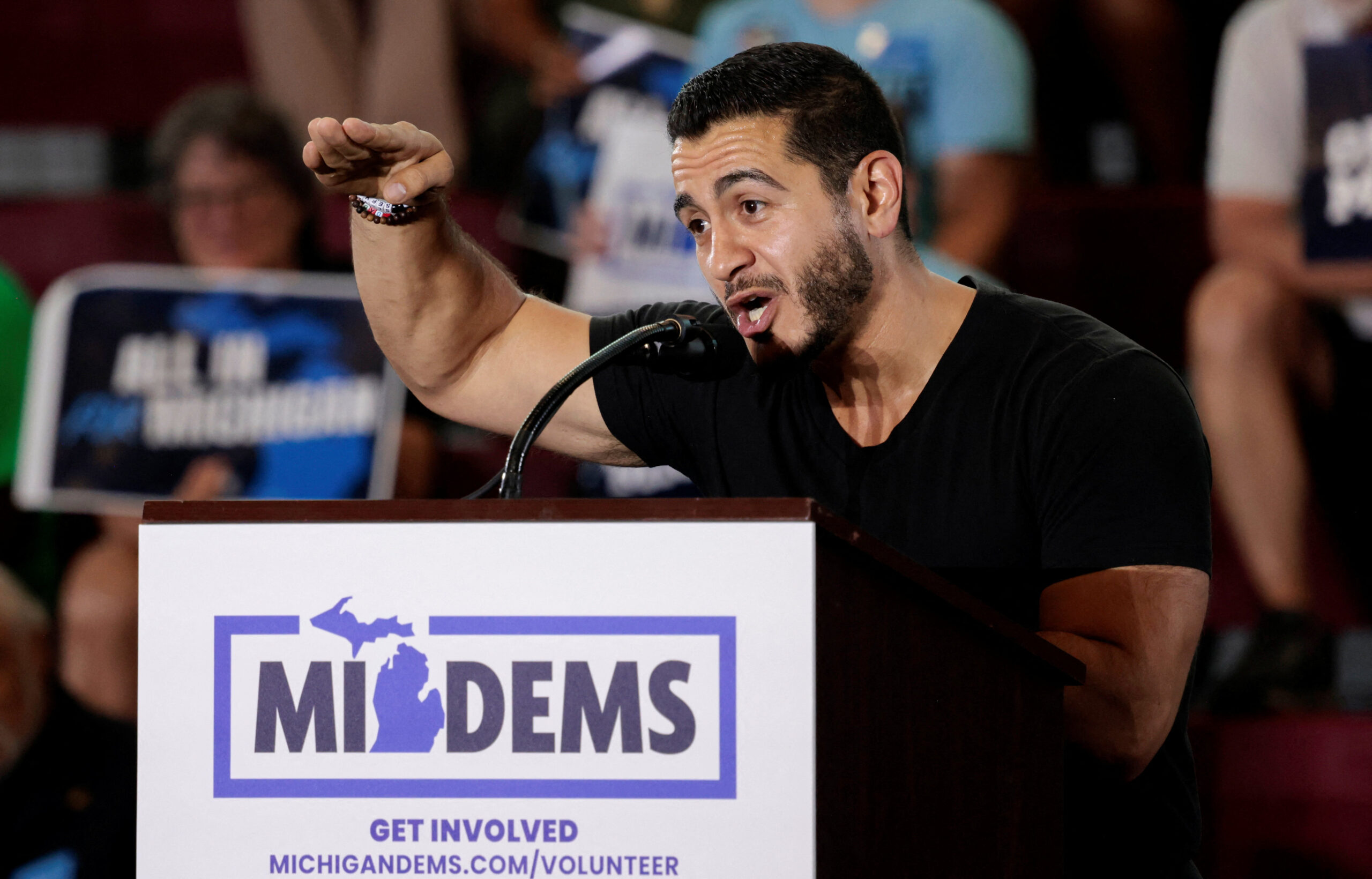
New reporting has emerged on the family of Abdul El-Sayed, the Democratic Socialists of America-aligned candidate for U.S. Senate in Michigan. El-Sayed’s sister, an assistant professor at the University of Chicago, described her employer as a colonial institution and said the war in Gaza pushed her toward campus organizing after years of what she called disdain for that kind of activism. El-Sayed’s mother worked for the Islamic American Relief Agency until 2004, the year the U.S. Treasury Department linked the organization to financing for al-Qaeda, the Taliban and Hamas.
During a documentary profile of El-Sayed, filmed during his run for Michigan governor, he reportedly asked a crew to avoid showing certain books on his study shelf during filming, including a work by Abu Ameenah Bilal Philips, an unindicted co-conspirator in the 1993 World Trade Center bombing and a figure who has been barred from entering the United Kingdom, Australia, Germany and Denmark over his public statements. Hassan Piker, an online streamer and ally of El-Sayed’s campaign, whose brother holds a security clearance and has worked on defense contracting projects, including on Air Force One. Recent polling from Nate Silver was cited showing El-Sayed and Republican Mike Rogers in a statistical dead heat in the Michigan Senate race.
Dan Proft was then joined by Zuhdi Jasser, a physician, former U.S. Navy lieutenant commander, president of the American Islamic Forum for Democracy, co-founder of the Muslim Reform Movement and a Republican candidate for Congress in Arizona’s Fourth District. Jasser characterized El-Sayed’s candidacy as part of what he called a two-generation effort by Muslim Brotherhood-aligned political networks to cultivate candidates in American politics, tracing the movement’s origins to Egypt. He argued that global politics today can be understood as a three-way split between Western liberal democracy, Islamist theocracy and the socialist politics associated with the Chinese Communist Party, and said El-Sayed’s political coalition draws from the latter two.
Jasser argued that Democratic politicians and party figures have been slow to reckon with what he described as an emerging pattern of Islamist-aligned candidates entering mainstream politics through appeals to economic and identity-based grievance, pointing to endorsements of El-Sayed’s campaign from national Democratic figures including Pete Buttigieg and David Axelrod. He drew a historical parallel to Iran’s 1979 revolution, in which he said a Marxist party allied with Islamist revolutionaries before later being suppressed once the Islamists consolidated power.
The conversation also addressed comments made in 2019 by Hassan Piker, in which Piker suggested the September 11th attacks were connected to U.S. foreign policy. Proft and Jasser discussed a recent exchange in which Piker, pressed by journalist Mehdi Hasan, said the remarks could have been phrased better and that he had apologized for how they were received. Jasser said he did not view the walk-back as sufficient, arguing that public figures in this political space rarely explicitly condemn groups such as al-Qaeda, the Taliban or Hamas, or the ideology behind attacks carried out by U.S.-radicalized extremists.
Jasser said he has raised similar concerns directly at mosques and in debates around the country, arguing that some prominent Muslim commentators have made and later disavowed statements he considers antisemitic without offering a broader defense of Western principles such as free markets, property rights or women’s rights. He said his political organization, the Clarity Coalition, is built around opposition to Islamist ideology while explicitly welcoming coalition partners including gay rights advocates and feminists who share a commitment to liberal democratic values.
Asked by Proft whether the political dynamics seen in Dearborn, Michigan could spread to other metropolitan areas, Jasser said he believes the country could see significant political change within a few election cycles if what he called grievance-based identity politics continues to gain traction in both major parties, though he argued the pattern is currently more pronounced on the left due to its emphasis on identity politics over individualism. He pointed to his own Arizona congressional race, saying his opponent, Democrat Greg Stanton, has declined to sign a party pledge affirming support for free markets, capitalism and strong national security that Jasser said only a handful of House Democrats have signed.
Jasser closed by arguing that vetting of El-Sayed’s worldview, rather than isolated past statements, should be the central issue in the Michigan Senate race, and pointed listeners to his campaign website for more information on his own run for Congress.