




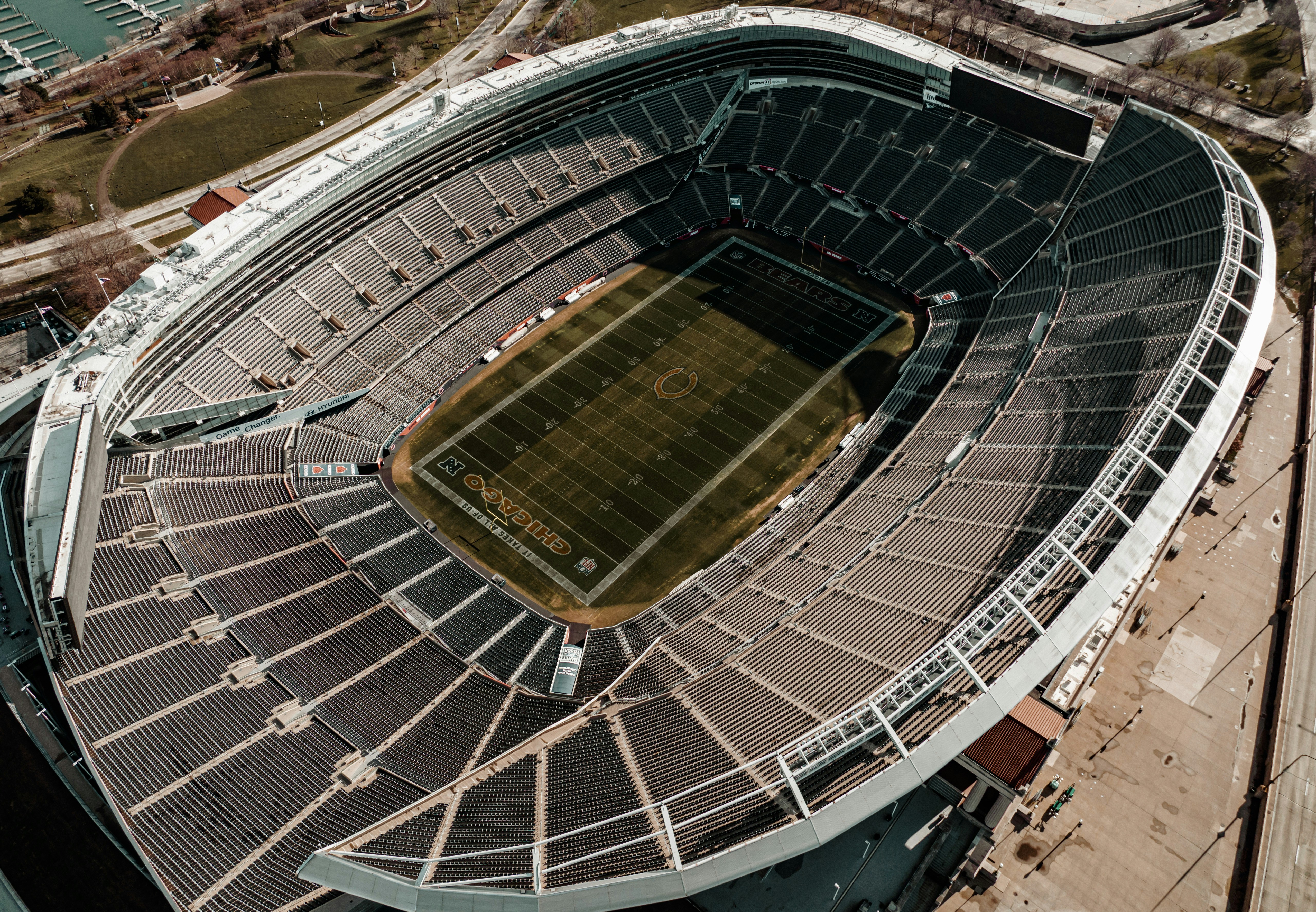
As Illinois state Representative Cam Buckner advances legislation in Springfield to provide public support for a potential Bears stadium in Arlington Heights, University of Illinois professor emeritus of geography, regional science, economics, and urban and regional planning Geoffrey Hewings joined Dan Proft on Chicago’s Morning Answer to argue that the proposed terms represent a poor return on public investment and that the Bears ownership, like every major sports franchise that has played this game before them, is benefiting from a fundamental imbalance between sophisticated private negotiators and outmatched public officials.
The Buckner legislation would allow the Bears or any developer investing over five hundred million dollars to negotiate property tax certainty with local governments for up to forty years, replacing standard property taxes with negotiated payments in lieu of taxes. A separate infrastructure package would cover roads, sewer, and utility work at the site, the cost of which has not yet been publicly specified. The state of Indiana has separately offered approximately one billion dollars through a sports authority it established for the competing Wolf Lake site in Hammond.
Hewings said the straightforward answer to whether this represents a good deal for Illinois taxpayers is no, and he outlined three reasons. First, there are almost certainly better uses for the public funds being contemplated. Second, the Bears organization is not in financial distress that would justify public assistance, and the franchise is one of the most valuable properties in professional sports. Third, the claimed economic benefits of publicly financed stadiums are consistently overstated and empirically unsupported. He noted that Los Angeles went nearly a decade without an NFL franchise during the period between the Rams and Raiders departures and the later arrivals of the Rams and Chargers, and that the regional economy performed well throughout, undermining the argument that losing a team would be economically devastating.
The broader academic literature on the question is unambiguous, Hewings said. Meta-analyses of studies examining the return on investment from publicly financed sports stadiums almost universally find that the deals are losers for taxpayers, with the level of public subsidy typically far exceeding any measurable economic benefit. One reason, he said, is that a large percentage of professional sports players and senior staff do not actually reside in the region where they play, maintaining primary residences elsewhere and spending most of their income outside the local economy. The local economic churn that makes public investment in ordinary businesses attractive, with employees buying homes, spending on goods and services, and sending children to local schools, is substantially diminished when the workforce is transient and highly compensated people are directing their spending to other markets.
Hewings pointed to the privately financed soccer stadium currently under development in the Chicago area as the model that the Bears situation should be following. That project will use some public funds for necessary infrastructure but does not ask taxpayers to subsidize the core facility, a distinction he said someone needs to be willing to draw even in the face of predictable pushback from sixty or seventy thousand disappointed fans. He framed the issue as a question of priorities for a region of eight and a half million people, the vast majority of whom receive no particular benefit from subsidizing a franchise that plays eight to ten home games per year.
Proft raised the comparison to the 1980s standoff in which White Sox owner Jerry Reinsdorf threatened to relocate the team to St. Petersburg, Florida, unless Illinois publicly financed a new stadium, a threat that then-Governor Jim Thompson ultimately capitulated to in what Proft described as a deal that remains embarrassing in retrospect. Hewings said the pattern of learning nothing from previous capitulations and simply repeating the cycle is a consistent feature of how Illinois handles these negotiations. He added that the outstanding debt from the Soldier Field renovation of roughly twenty years ago has received almost no public attention in the current stadium discussion, raising the question of whether that obligation will simply be absorbed by the city while the Bears walk away to Arlington Heights having never retired it.
Hewings drew a pointed contrast between the public anxiety over protecting the Bears’ five hundred to one thousand employees and the near-total official indifference when Citadel founder Ken Griffin relocated his firm and its three thousand one hundred employees to Miami. The first thousand of those employees, Proft noted, were individually wealthy enough to generate the kind of local economic churn that actually produces substantial tax revenue, yet that departure generated no comparable legislative mobilization. Hewings said the disparity reflects the emotional pull of a beloved sports franchise distorting what should be a straightforward cost-benefit analysis.
He offered an example from Spain, where he is currently spending time, of a local soccer club that converted the retail space beneath its stadium stands into a shopping complex it developed and subleases itself, generating enough revenue from supermarkets, restaurants, and shops to fund stadium renovations without any public contribution. People park there for free and shop even on non-game days, creating genuine community economic activity that the club monetizes rather than asking taxpayers to subsidize. He said the failure to structure similar arrangements in American stadium deals reflects both the sophistication gap between private ownership and public negotiators and a political culture that treats the word public good as sufficient justification for any expenditure without requiring the hard financial accountability that would be demanded of any private investment.