




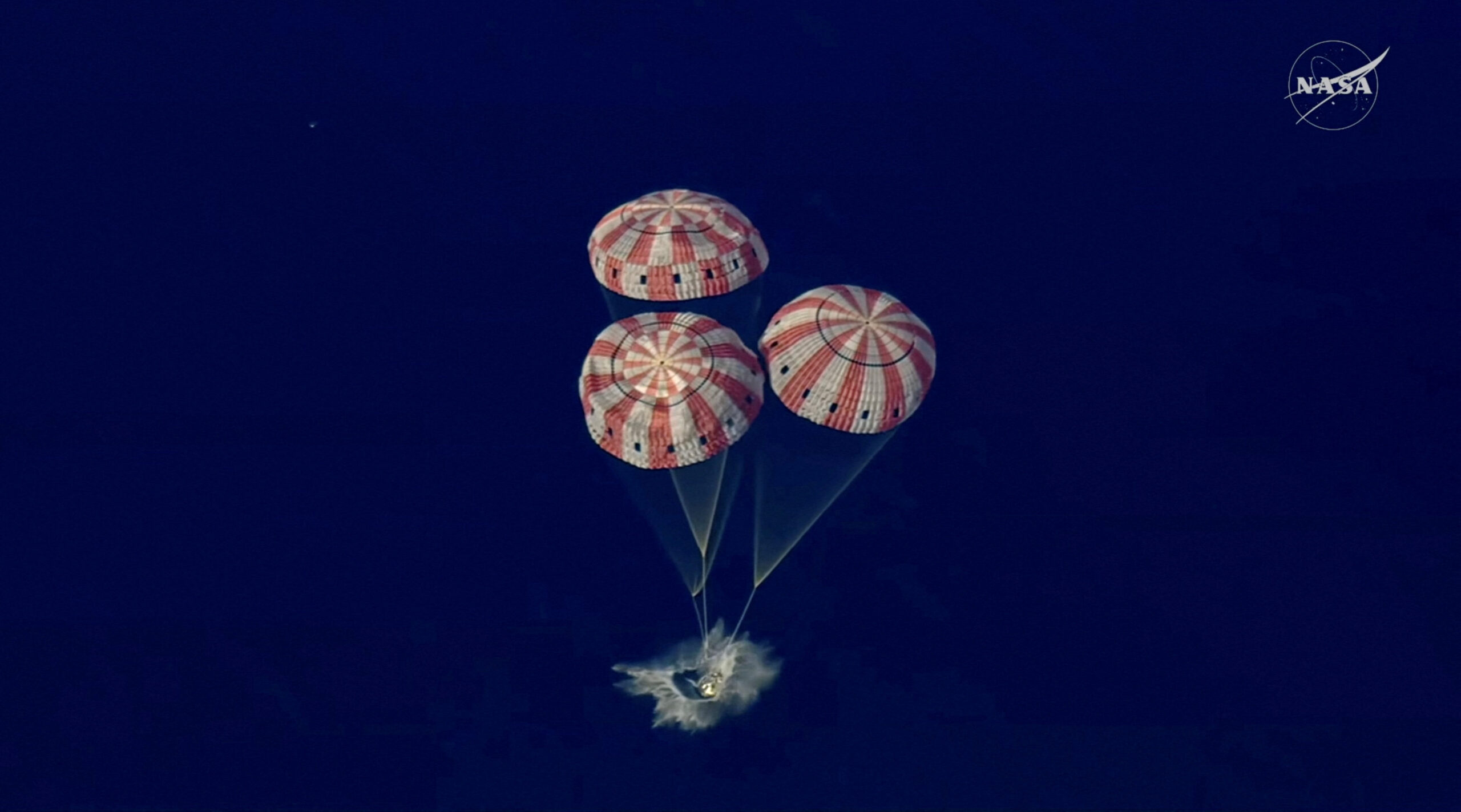
The Artemis II astronauts held a post-splashdown press conference this week that Dan Proft described as impressive from beginning to end, with Mission Specialist Victor Glover thanking God publicly and Canadian astronaut Jeremy Hansen telling the assembled press that the four-person crew was a mirror reflecting humanity back at itself.
Jack Burns, Professor Emeritus in astrophysical and planetary sciences and physics at the University of Colorado Boulder and associate director of the Colorado Space Policy Center, joined Chicago’s Morning Answer to assess the mission’s significance and explain what the Artemis program’s revised schedule means for the timeline to putting humans back on the lunar surface.
Burns said Artemis II was about as close to a flawless execution as a human spaceflight mission can achieve, with a countdown that began hours in advance, a launch that occurred precisely on time with no holds, and a successful splashdown in the Pacific Ocean exactly as planned. He said he has been telling people he has not seen a human launch go off that precisely in his forty-five-plus years of working in and around NASA. The mission accomplished its primary objectives of testing the Orion spacecraft’s life support systems, navigation, and crew interfaces with human astronauts aboard for the first time, and the camaraderie visible among the four crew members at the post-mission press conference reflected the quality of the team NASA assembled.
On the path to an actual moon landing, Burns explained that NASA Administrator Jared Isaacman has recently modified the Artemis sequence in a way that inserts an additional orbital mission before the lunar surface attempt. Artemis III, now scheduled for 2027, will conduct a high Earth orbit rendezvous mission to practice the docking and approach procedures the astronauts will need to execute when they transfer from the Orion capsule to the lunar lander during the actual moon landing mission. This is the critical new step that Artemis III will test before human lives depend on it. Two lunar landers are under development in parallel, one from SpaceX and one from Blue Origin, and both will need to demonstrate the ability to land on the moon without a crew before NASA will commit astronauts to them. The actual moon landing, now designated for Artemis IV, is targeted for sometime before the end of the decade.
Burns addressed the obvious question of why it has taken nearly six decades to return to the moon after Apollo 11 in 1969. He traced the gap directly to Richard Nixon’s 1970 cancellation of the Apollo program, which had three fully funded and hardware-ready missions remaining, including what would have been Apollo 18, 19, and 20. At its peak, the Apollo program consumed approximately four and a half percent of the entire federal budget. NASA today receives less than four-tenths of one percent. The fundamental change that has made returning to the moon newly viable is not political will but technological economics. Fifty years of development in rocket propulsion, avionics, computing, and advanced artificial intelligence tools have driven down the cost of spaceflight by orders of magnitude and opened the field to private sector entrepreneurs in ways that simply did not exist during the Apollo era. Burns noted that he recently sent a radio telescope payload to the moon on a NASA commercial lander for approximately one hundred million dollars, a fraction of the billions Apollo required for equivalent capability.
He connected those commercial and technological developments to the broader strategic rationale for the current program, which he said differs fundamentally from Apollo’s singular government-directed goal of getting boots on the surface before the Soviets did. Today’s program is built around the longer-term vision of establishing a sustained human presence off Earth, beginning with learning to live off the lunar land and eventually expanding to Mars, supported by a constellation of private companies whose business models depend on making spaceflight increasingly routine and affordable. National security, commercial development, and scientific exploration all converge in that mission in ways they did not during Apollo.
Proft raised recent comments by Tennessee Representative Tim Burchett, who has said publicly that he has received classified briefings whose contents would cause civil unrest if disclosed to the American public, statements widely interpreted as alluding to evidence of extraterrestrial life or undisclosed information about unidentified aerial phenomena. Burns said he has not seen any such documentation in four and a half decades of working in and around NASA, and offered the observation that NASA is notably bad at keeping secrets, suggesting that if the organization possessed genuinely extraordinary information of that kind it would almost certainly have leaked by now. He acknowledged that unexplained atmospheric phenomena exist and warrant further investigation, but said he has seen no credible evidence of extraterrestrial beings on Earth and does not know anyone who has.