




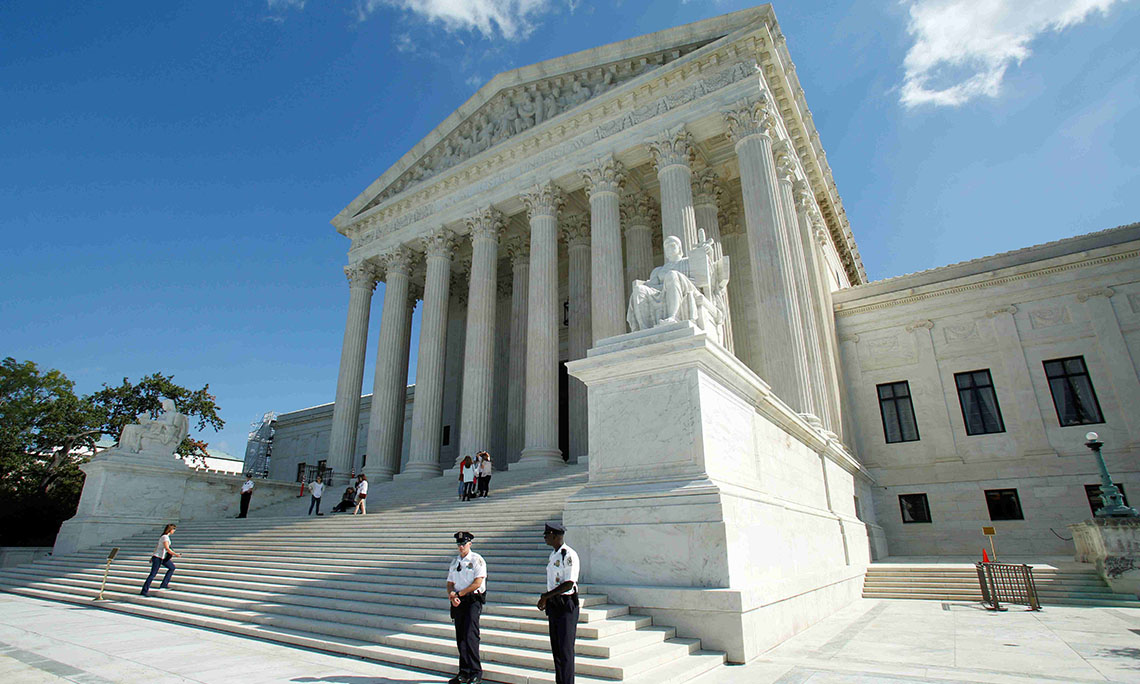
The redistricting wars intensified this week as the Supreme Court cleared the way for Alabama to use a congressional map that a lower court had blocked as racially discriminatory, with Justice Sonia Sotomayor dissenting and arguing the decision would dilute Black voting power.
Josh Blackman, who holds the Centennial Chair in Constitutional Law at South Texas College of Law in Houston and is a contributing editor to Civitas Outlook, joined Dan Proft on Chicago’s Morning Answer to explain what the Alabama ruling means in the broader context of the Court’s Callus decision and the ongoing redistricting fights in Virginia, South Carolina, and across the South.
Blackman said the Supreme Court’s line of redistricting decisions has established one foundational principle that sounds obvious but contradicts decades of practice: when drawing legislative maps, legislators may consider partisanship and incumbent protection but may not consider race. For roughly half a century, federal courts and state legislatures operated under the assumption that the Voting Rights Act required the creation of majority-minority districts to ensure Black representation in Congress. This produced maps of striking geographic absurdity, merging communities that shared nothing except racial composition, connecting voters in New Orleans to voters in Baton Rouge to voters in the northern panhandle of their states with no regard for shared economic interests, cultural ties, or municipal relationships. The Court said that era is over.
He said the ruling exposes a double standard that has operated in American redistricting for decades. In the South, Democrats received what Blackman described as a guaranteed bonus through majority-minority district requirements that reliably produced seats for Democratic candidates. In the North, no equivalent protection was extended to Republican voters. Illinois Republicans are down to a handful of congressional seats. Massachusetts has essentially no Republican representation in Congress. Both outcomes were produced deliberately through partisan gerrymandering that courts tolerated, while simultaneously requiring Southern states to maintain race-based districts in ways that benefited Democrats. The Supreme Court, he said, has said it will apply the same rule everywhere, and that rule treats equal treatment of voters rather than guaranteed group representation as the governing standard.
Proft raised the broader point that the argument for majority-minority districts rests on a factual premise that no longer reflects American political reality. The implicit assumption is that majority-white districts will not elect Black candidates. But a white-majority district in Memphis elected Democratic Congressman Steve Cohen for years. Black candidates have won governorships, Senate seats, the presidency, and mayoralties in majority-white jurisdictions across the country. Blackman said Justice Clarence Thomas addressed this directly, noting that the logic claiming Black voters in the minority cannot elect their preferred candidates applies with equal force to Republicans living in Illinois or Massachusetts, and that the appropriate standard for whether a candidate wins is whether they attract majority support, not whether their district has been engineered to guarantee a particular demographic outcome.
The Virginia situation produced the most dramatic illustration of Democratic willingness to break institutional norms to preserve map control. After the Virginia Supreme Court struck down the referendum that had redrawn the congressional map, citing clear violations of the state constitution in how the amendment was passed, Democratic legislators in the state Senate floated a proposal to retroactively lower the mandatory retirement age for Virginia Supreme Court justices from seventy-five to fifty-three, which would have removed every sitting justice simultaneously, allowing the Democratic-controlled legislature to repack the court with justices who would approve the new maps. Blackman said this is wild and revealing. Even an impeachment requires a formal vote. The proposed age-limit maneuver would have quietly removed judges by changing a procedural rule, including removing justices who had actually voted in favor of the Democratic position. He said the Democratic Senate leader ultimately declined to pursue it as too extreme, but acknowledged the underlying impulse reflects what happens when people who have held power lose it and become increasingly desperate to retain it by any available means.
He said the fixation on race-based map drawing is not only constitutionally prohibited under the Court’s current jurisprudence but actively harmful, replacing the legitimate democratic question of whether a candidate can build a winning coalition with an engineered guarantee that a particular demographic will produce a particular kind of representative. The equal rule the Court is now applying, he said, is better for democracy, better for voters of all backgrounds, and long overdue.