




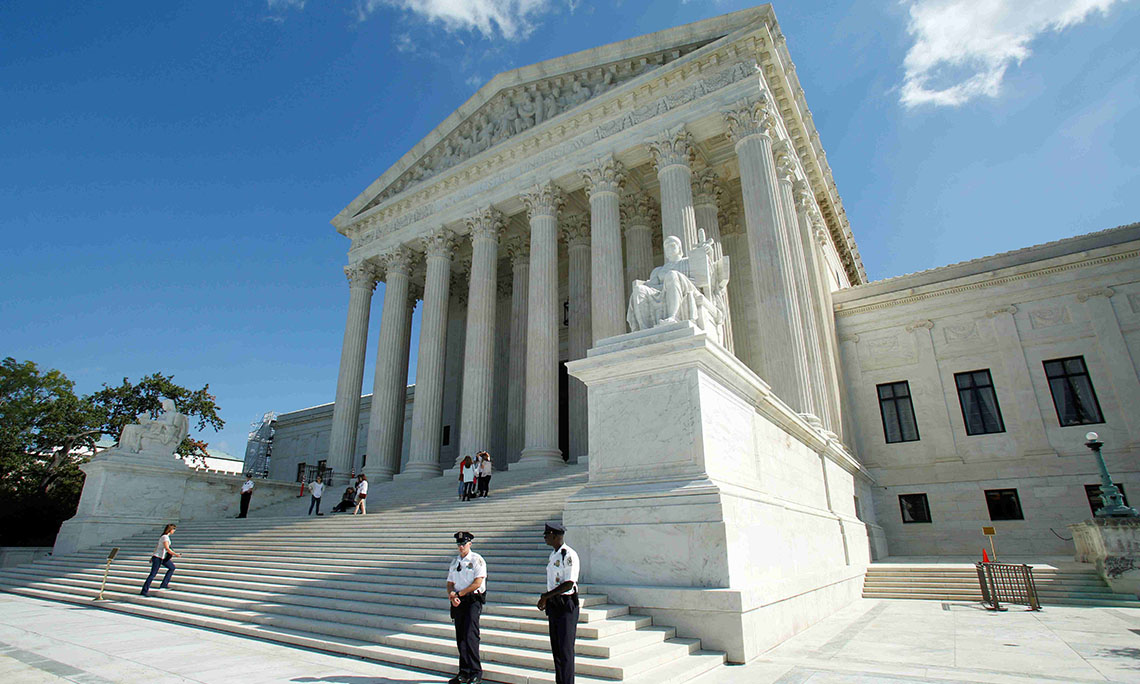
Oral arguments on President Trump’s executive order ending birthright citizenship for children of people unlawfully or temporarily present in the United States were set to begin Thursday, with Trump indicating he might attend and other cabinet members planning to appear as well.
Randy Barnett, professor of constitutional law at Georgetown University and author of Felony Review: Tales of True Crime and Corruption in Chicago, joined Dan Proft on Chicago’s Morning Answer to assess the constitutional merits of the case and what the justices are likely to do with it.
Barnett said he published an op-ed in the Wall Street Journal Thursday morning arguing that Trump has the better of the constitutional argument, a position he has been developing over the past year. A year ago, writing in the New York Times, he suggested Trump might have a stronger case than conventional wisdom allowed. Since then, he said, there has been an explosion of originalist scholarship on both sides of the question, with each side systematically vetting the other’s arguments. That process, he said, has now produced enough analytical clarity to reach a conclusion, and his conclusion is that the Fourteenth Amendment’s citizenship clause does not provide birthright citizenship for children of people who are unlawfully or temporarily present in the United States.
The entire debate, Barnett said, turns on four words: subject to the jurisdiction thereof. The Fourteenth Amendment provides that all persons born or naturalized in the United States and subject to the jurisdiction thereof are citizens, and Barnett said the conventional wisdom has largely ignored that second requirement while treating birth on American soil as sufficient on its own. At the time the amendment was enacted, he said, there were three universally recognized categories of persons not considered subject to the jurisdiction of the United States for citizenship purposes: children of diplomats, children of invading armies, and children of Native Americans affiliated with a tribe. The question before the court is whether the concept underlying those three exceptions, what it means to be fully subject to American jurisdiction, is broad enough to also exclude people who are unlawfully or temporarily present in the country, or whether those three categories represent the outer limits of the exception.
Barnett said the strongest textual support for Trump’s position comes from two places. The first is the word reside in the citizenship clause itself, which states that citizens of the United States are also citizens of the states in which they reside, suggesting residency rather than mere temporary presence is built into the original understanding of what citizenship requires. The second is the Civil Rights Act of 1866, which the Fourteenth Amendment was specifically designed to constitutionalize. The original language of that act granted citizenship to persons born in the United States and not subject to any foreign power, which Barnett said reflects the same concept as subject to the jurisdiction thereof but in plainer terms that make the exclusion of non-permanent residents more evident. After the amendment was ratified, Congress repassed the Civil Rights Act using its original language, which Barnett said is significant evidence that the framers did not intend the amended constitutional language to change the underlying meaning of the act they were enshrining.
On the Wong Kim Ark case of 1898, which is typically cited as the Supreme Court precedent establishing birthright citizenship and which Proft noted has governed the interpretation of the clause for 128 years, Barnett said the conventional wisdom misreads what the case actually held. The question presented in Wong Kim Ark was whether the American-born child of permanent legal residents of the United States was a citizen. The court held that he was, and the government’s current position does not contest that result. Trump’s executive order would not affect the children of green card holders, who would remain citizens under the order. Barnett said the case has been stretched far beyond its actual holding by those who use it to argue for birthright citizenship regardless of the legal status of the parents.
He addressed directly the possibility that the court might sidestep the constitutional merits by ruling that the executive order is an improper vehicle for implementing a change of this magnitude, arguing instead that Congress would need to act. Barnett said that argument conflates two distinct constitutional powers. Congress holds the naturalization power, which is the authority to grant citizenship by statute to those not automatically entitled to it under the Fourteenth Amendment. The president’s executive order is not an exercise of the naturalization power but rather an expression of the president’s independent authority and obligation to interpret and apply the Constitution, subject to judicial review, which is precisely what the current proceedings represent. A ruling that the president lacks the authority to issue the order would therefore require the court to articulate a novel and significant limitation on executive power that has no clear constitutional basis.
Proft also asked Barnett about a separate executive order Trump issued the previous day directing the Department of Homeland Security, with assistance from the Social Security Administration, to compile a verified list of American citizens, requiring the Postal Service to send mail ballots only to approved voters on that list, and mandating unique barcode tracking on ballots transmitted in secure envelopes. Barnett acknowledged he had been largely offline for several days aboard what he described as a floating 1960s rock and roll music festival cruise in the Caribbean and had not yet seen the order, but said it sounded sufficiently interesting that he would need to turn his attention to a new op-ed upon returning to port.